Showing posts with label A Toast to Perennials. Show all posts

Sunday, September 30, 2012

Henry Eilers


Henry Eilers rudbeckia


It was love at first sight when I met Henry Eilers. The plant, that is.

This wasn't just another Tom, Dick or Harry. Or even another Black-Eyed Susan. This was a tall, stately flower with petals that curled under to become quills, a flower that would shout a cheery "welcome home"  when I pulled up in the driveway after a hard day at work.

Rudbeckia subtomentosa 'Henry Eilers' has now graced my front yard for two years and is the star of the late summer/early fall garden. Its flowers are just starting to fade after blooming for more than a month, despite the ongoing drought.

But then Henry Eilers, also known as the sweet coneflower, is made of pretty strong stuff.

It hails from downstate Illinois where it was found just south of Springfield along Historic Route 66. This was one of the nation's first highways and became known as the Mother Road during the Dust Bowl days as people drove from Chicago to California in search of a better life. A younger generation knows it as the road featured in the Pixar movie "Cars."

Henry Eilers
Route 66 in Illinois was originally surrounded by tallgrass prairie -- most of which has long since vanished. Henry Eilers, the plant, was found in an undisturbed 8-acre remnant of that prairie which Henry Eilers, the man, and others are now working to preserve.

A retired nurseryman, Eilers has been active in the several conservation efforts near his hometown of Litchfield for many years. His name even graces a local 250-acre nature preserve on Shoals Creek.

Henry Eilers, the plant, is every bit as hard-working as its finder. It likes full sun but does well in the slightly shady spot where I have it planted. In addition to having a long bloom period, it makes a great cut flower. The leaves also smell like vanilla if crushed or dried.

The only apparent drawback is its height. This plant supposedly gets to be about 5-6 feet tall, which might require staking. In my garden, however, it has only gotten about 3 feet tall so far. That could be because both summers have had their share of 100-degree days which may have limited growth. I know that has been the case at several local prairies.

On the other hand, it could be that my plant was mislabeled. There's now a 'Little Henry' variety that only gets about 3 feet tall. Such things do happen.


Henry Eilers rudbeckia mums asters
Henry Eilers with asters and mums at the Chicago Botanic Garden
Guess I'll have to wait for a more "normal" year -- whatever that is -- to make such a determination. If Henry ever does get that tall, it will probably have to be moved to another part of the garden.

Whatever the final verdict, though, it's definitely sticking around. Henry Eilers is a nice complement to asters and mums. And I'll never find a cheerier, harder working plant to take its place.

By Karen Geisler


Henry Eilers Chicago Botanic English Walled Garden
Henry Eilers at the Chicago Botanic Garden English Walled Garden


Sunday, August 5, 2012

Blades of Grass


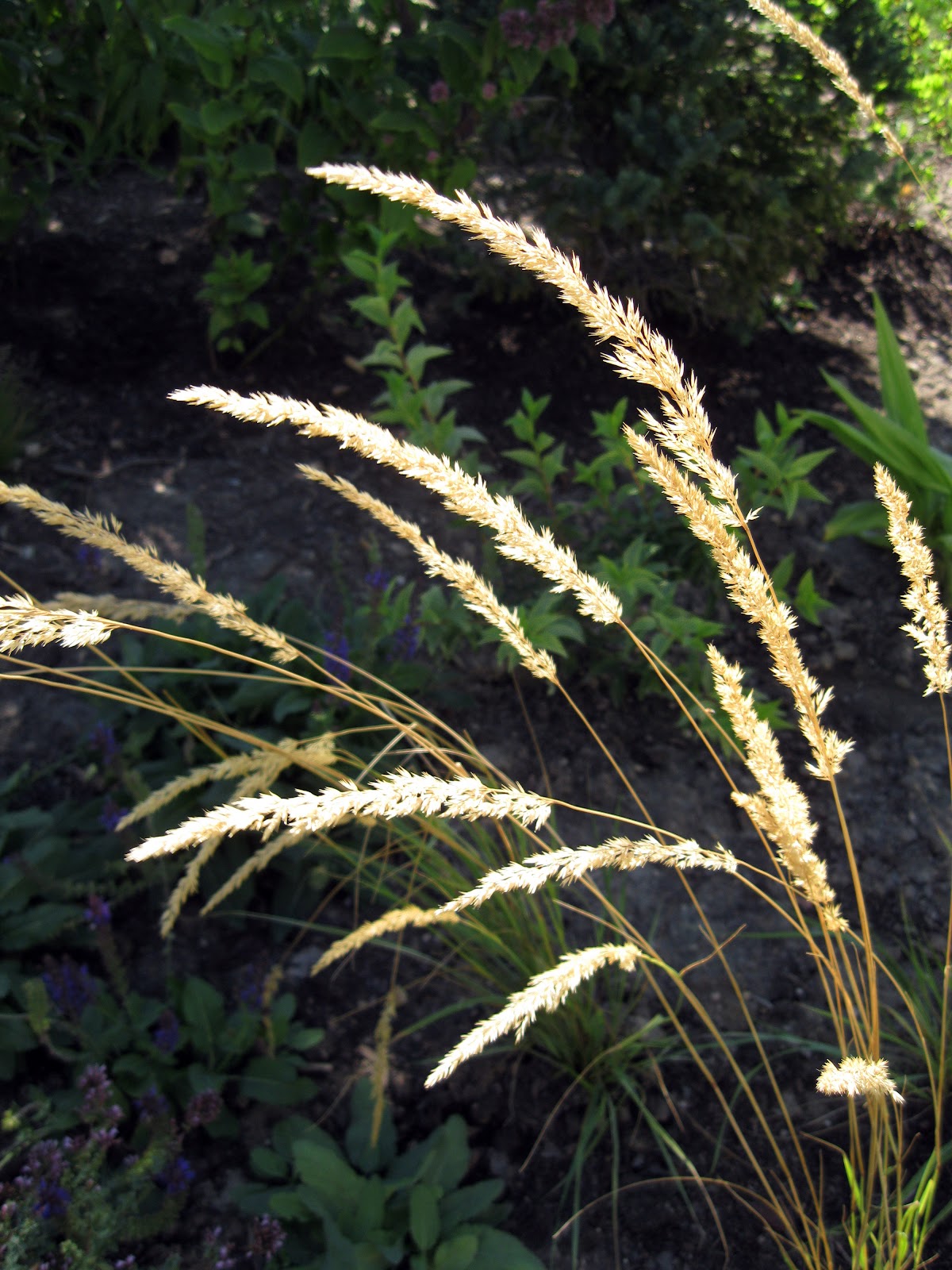
Helictotrichon sempervirens


"I believe a leaf of grass is no less than the journey work of the stars."
-- Walt Whitman, Leaves of Grass

Whitman probably wasn't referring to ornamental grasses when he wrote those words, but I'd like to think he's approve of them if he were around today. After all, most of the prairies of his time have disappeared.

I’ve come to appreciate grasses – at least the ornamental ones -- more and more. That’s especially true with this year’s drought. They’ve needed next to no water and no special care. Of course, that’s not true for my sorry excuse of a lawn, but then that has been shrinking steadily over the years as my garden has grown.
I’m not sure why but gardeners seem to be divided into three camps when it comes to ornamental grasses.
1)      Love ‘em.  Give me more!
2)      Hate ‘em. Too messy looking, too big or need more sun than I have.
3)      Tentative. I’d like to try them but aren’t they invasive?
I started out in category #3 but switched to #1 as I learned more about ornamental grasses. I’ve generally stuck with the clumping varieties, which are much more well behaved than the running ones. I’ve used some natives as well as some non-native ones, with most of them under 3'-4’ tall.
What I like best about ornamental grasses is the texture they provide, a nice contrast to that of many perennials and shrubs. They also provide movement, with their seed heads swaying in the wind. The foliage can be left up in the fall to provide some winter interest. And, last but not least, they are sustainable, needing little care in even the most challenging of summers.
Here are a few of my current favorites.
Blue oat grass (Helictotrichon sempervirens)(shown above) is a cool season grass. It comes up early and “blooms” in late spring to early summer. The blue-colored blades keep their color throughout the season. These echo the color in a Globe Blue Spruce I have nearby in my front yard.
Calamagrostis x acutiflor 'Overdam'
The seed heads of Overdam Feather Reed Grass

Overdam Feather Reed Grass (Calamagrostis x acutiflora ‘Overdam’) is similar to the Karl Foerster grass that has finally been popping up in public places, like fast-food restaurants, strip malls and gas stations. It’s different in that it is more compact and its leaves are variegated. It’s sterile. I also have a similar grass called Avalanche, which has slightly more green than white in its leaves.

These two grasses and all of the ones  listed below are warm season grasses. They really need warm weather before they kick into high gear.

Morning Light Maiden Grass (Miscanthus sinensis ‘Morning Light’) is breathtaking when it is back lit, so be sure to put it in an appropriate location. It has very fine variegated foliage and good winter interest. It can get to be about 4’-6’ but it’s so light and airy that you won’t mind.
Panicum virgatum 'Northwind'
Northwind Switch grass contrasts nicely with the Mohican viburnum behind it.

Switch grass (Panicum virgatum) is native to the tallgrass prairie, which once covered most of Illinois. I’m particular to the Northwind cultivar but I’m also dying to try Shenandoah, which has more red in it. Switch grass provides great winter interest and is also very good in dried fall arrangements.

Pennisetum orientale 'Karley Rose'
Karley Rose Fountain Grass seed heads sway in the wind
Karley Rose Fountain Grass (Pennisetum orientale ‘Karley Rose’) and Red Head Fountain Grass (Pennisetum alopecuroides ‘Red Head) have been interesting. I thought Karley Rose as only hardy to zone 6 so I planted it near a maple tree in my Zone 5 garden as an annual. It has been coming back ever since.  It has spread somewhat but not obnoxiously so. I love the swaying of the seed heads, which start out pink and turn a light beige.

Red Head, on the other hand, has red bottlebrush-type plumes.  It's nice but has seeded itself in the garden so it’s currently on probation. I'm hoping that that the spread is due to last year's extraordinarily long, warm fall.
Sporobolus heterolepsis 'Tara'
The seed heads of Tara Prairie Dropseed
Sporobolus heterolepsis 'Tara' in the garden
Prairie dropseed in the garden

Prairie Dropseed (Sporobolus heterolepsis) adds an incredibly fine texture to the garden. I especially like Tara, which is a bit more upright than the species. It also has a smell this time of year that reminds me of popcorn. My husband can’t smell it, though. I’ve heard this anomaly from more than one person, although I’m not sure why that’s the case.
Of course, there are lots more ornamental grasses available, including several that will take shade or even dry shade. I've recently added Little Bluestem (Schizachyrium scoparium), a butterfly host plant and tallgrass prairie native, so I will have to see how it does.
The deer that occasionally visit my garden never touch the ornamental grasses – another plus. Care is pretty simple. You just need to chop them down to about 4-6” high before the growing season starts.  They do need to be divided every so often and the roots go deep so be sure to sharpen your shovel beforehand.
If you’ve never tried ornamental grasses in your garden, I hope you’ll give them a try. Who know? Maybe you’ll move into category #1 as well.

By Karen Geisler

Monday, July 2, 2012

The Fireworks Flower


Coral Reef bee balm
Monarda didyma 'Coral Reef'

Fireworks are everywhere this time of year. They're the ultimate celebration of summer, an explosion of color in the night sky.

So I was a bit puzzled a few years back when my son said he really liked our "fireworks flowers." I had no idea what he was talking about.

Imagine my surprise when he took me to the front of our house and pointed to the Raspberry Wine bee balm (Monarda didyma 'Raspberry Wine').  There were more than enough flowers for a bouquet as well as the bees and hummingbirds, so we took some of the "fireworks" inside.

The name has stuck ever since at our house.

One of monarda's many common names actually is "firecracker flower" according to an online search. I always think of a firecracker though as being loud and obnoxious. Fireworks, now fireworks are pretty. And these flowers can be very pretty when in bloom.

Monarda more often is called bee balm or Oswego tea. The latter name is a reference to the Oswego tribe of western New York. Many Colonists apparently used monarda leaves after the Boston Tea Party as a way to protest the British tax on East Indian tea. And yes, it does attract bees so keep that in mind when choosing a location.


Bee on Raspberry Wine bee balm
A bumblebee on Monarda didyma 'Raspberry Wine'

This native plant is a great way to attract pollinators to your garden. It's hardy from zones 4 to 9 and generally grows about 2 to 4 feet, with a spread of about the same size. Two new introductions, Petite Wonder and Petite Delight, are smaller at about 18". Monarda generally flowers in July for me, although it's much earlier than usual this year due to the extremely warm weather.

Its flowers come in white, pink, red, rose and purple. The leaves, when rubbed, have a smell that can only be described as "spicy."

The biggest concern with monarda usually is mildew. I've found the plant definitely needs at least six hours of sun to help ward off the white stuff. Good air circulation helps as well.

Many of the newer varieties have been bred to be more mildew resistent. This year has been so hot and dry in the Chicago area that mildew hasn't been a problem anywhere in my garden. There have been many summers, however, when my monarda wasn't so lucky.

The best thing to do in such cases is to cut the plant back to the new foliage near the roots. You also may have to do this if the foliage starts looking ratty once the plant has finished blooming. That's why I originally put Raspberry Wine toward the back of my border. That way it will be hidden from view if I have to cut it back.


Gardenview Scarlet monarda
Monarda didyma 'Gardenview Scarlet' in the garden


Be sure to give monarda lots of room to spread. As a member of the mint family, it's usually pretty vigorous. I think it actually looks better in a drift. And don't worry if it gets too big for its original location. It usually spreads by underground runners and I've found the new plants are easy enough to remove.

As you may have guessed from my comments above, I'm usually a bit of a pyro around Independence Day. Given the current drought, I think I'm going to have to limit my fireworks this year to "fireworks flowers." Maybe not as exciting, but much, much safer.

By Karen Geisler

Have a great Fourth of July!

Closeup Coral Reef' monarda flower


Wednesday, June 20, 2012

Hats Off to 'Hummelo'

Hummelo betony
Stachys monieri 'Hummelo'

Mention the word “stachys” and many people think of Lamb’s Ears with its soft, fuzzy silver leaves and odd-looking flowers.

For me, though, the word brings to mind not Stachys byzantina, the botanic name of Lamb's Ears, but one of its green-leafed cousins, Stachys monieri ‘Hummelo.’

This plant, common name betony, is one of the longest-blooming perennials in my garden. It's right up there with the Blue Star False Aster (Kalimeris incisa ‘Blue Star’) and the Rozanne geranium.

Hummelo anchors my garden in the summer months, with groupings of three, five and even seven. This is definitely one plant where more is better. Thankfully that isn't hard as you can easily divide it.

The foliage of Hummelo betony
The foliage of Stachys m. 'Hummelo'
I love Hummelo's vibrant rosy-purple spikes that bloom from mid-June until sometime in August. Even when it’s not in bloom, the scalloped leaves with their crinkly texture provide a lot of interest.

That's one reason I have it along the sidewalk to my front door, where the leaves can be appreciated close up.

Hummelo thrives in my clay soil, whether full sun or light shade, and gets about 1 ½ to 2 feet tall, with a similar spread. It has never been bothered by deer or rabbits.

The plant also goes well with several others in my garden, including ornamental grasses, cone flowers (Echinacea), day lilies (Hemerocallis), bee balm (Monarda) and Walker's Low cat mint Nepeta x faassenii 'Walker's Low').

As with Kalimeris, I discovered this plant while doing a class report on Piet Oudolf, the Dutch “New Wave” designer who worked on the Lurie Garden in Chicago, the Gardens of Remembrance in New York City's Battery and numerous other public gardens.

He introduced the plant, which is named for the town where he lives in the Netherlands. I've always figured that any plant named after a hometown or spouse has to be good so I did more research.

I found that Hummelo had a good track record, topping the list of 22 Stachys varieties evaluated by the Chicago Botanic Garden from 1998 through 2004.

Richard Hawke, the CBG’s Plant Evaluation Manager, cited Hummelo for its “consistently heavy flower production, healthy foliage and a uniform habit” in his report. The plant also is reliably hardy in the Chicago area, being listed as Zone 4 to 8. That sealed the deal and Hummelo has been in my garden ever since.

I admit I'm intrigued by another recent introduction, Stachys officinalis ‘Pink Cotton Candy,’ which was found by the CBG as a seedling during the evaluation mentioned above. Its blooms are similar to those of Hummelo but in a much softer pink.

For now, though, I'm sticking with Hummelo. It's a true workhorse and a very pretty one at that.

By Karen Geisler

Hummelo betony has a compact growth habit.
Stachys m. 'Hummelo' has a nice compact habit

Tuesday, May 15, 2012

Bastard Balm

Melittis melissophyllum 'Royal Velvet Distinction'


Meet melittis melissophyllum 'Royal Velvet Distinction.’

It has small orchid-like flowers, a regal sounding name and a plant patent. So you'd expect it to have a great pedigree, right?

Nope. Its common name is Bastard Balm. Yes, you read that right. It’s a wildflower native to the U.K. and found all over central and southern Europe. Some European garden designers apparently look down on it as a result.

As an herb, it is used to treat anxiety, wounds and kidney problems. Exactly how it got its common name is (ahem) unclear.

This particular variety is more compact and has larger flowers than the species, according to a patent filed by its developer, Eleonore de Koning of the Netherlands. The violet purple and white flower color also is different from that of its parents and the leaves are a slightly darker green.

Its flowers still bloom in whorls around the upper part of the stems, though, a particularly delightful effect.

Royal Velvet Distinction in my garden
While initial listings for this plant said it was only hardy to USDA zones 6 or 7, it’s now being grown and sold in the Chicago as zones 5 - 9. That makes sense given that it’s a member of the always vigorous mint family.

Royal Velvet Distinction gets about 18" tall by 18" wide, likes full sun or light shade, and blooms from late spring to early summer.

It attracts butterflies and, as you might suspect with a botanical name from the Greek word for honey bees, it attracts them as well.

The leaves are a bit fuzzy and smell like lemon when rubbed. They supposedly remain that way even when dried.

I’m always a sucker for fragrant plants. And it looks like it would be perfect for a woodland garden. I couldn't resist buying it recently when I discovered it at my favorite nursery. I have it planted next to some Max Frei geraniums (geranium sanguineum), Tara dwarf prairie dropseed (sporobolus heterolepsis) and a Frosted Violet coral bells (heuchera).

Granted, the flowers aren't particularly big. And from what I've found on the Internet, it may take the plant a few years to settle in before it gets particularly floriferous. I'm willing to wait, though.

If nothing else, it should be one heck of a conversation starter.

By Karen Geisler

Sunday, April 29, 2012

On the Wings of Columbine


Music Blue and White columbine
Aquilegia 'Music Blue and White'

Mention the word "columbine" and most people, unfortunately, think of the tragic 1999 shooting at a Colorado high school of the same name. That's a shame because this plant is a wonderful way to move the garden from spring into summer.

The flowers always make me think of flying. Its sepals, the colored petals in the photo above, are the wings -- when viewed from the side at least. Its spurs, the long tubes on the back of the flower, look like the tail of a bird or a comet. In fact, this plant's common name stems from the Latin word columba, or dove.


Dove columbine
Aquilegia 'Dove'

Those long tubes serve a purpose. They hold the nectar favored by pollinators such as hummingbirds and moths. In fact, one scientific study showed that the length of these tubes has changed over the years to accommodate the available pollinators!

Columbine has been around practically forever and is native to most parts of the world. The wildflower version, aquilegia canadensis, has orange/red and yellow flowers that face downward. It will easily cross-pollinate and actively self-seed although you can avoid the latter problem by deadheading the flowers once they are finished blooming.

The plant has changed a lot since its beginnings as a wildflower. Size now varies from the 10-12" of Little Lanterns, a miniature version of the wildflower,and the Winky series to the 2-3 feet of the Songbird, Music and Origami series. Colors include all shades of pink, purple, yellow and red. Some flowers, especially those of the Songbird series, face upward. There are even columbines with green and yellow marbled leaves and others with double flowers.


Aquilegia vulgaris 'Leprechan Gold' leaves
Aquilegia vulgaris 'Leprechaun Gold' with
Alchemilla mollis in the background

Cultivation is easy. This plant prefers part shade and is hardy from zones 3 to 9. It likes a rich, consistently moist soil that is well drained and blooms from late spring to early summer. My garden especially needs more columbine this year as the early, warm spring caused most of my spring bloomers to finish up early.

A note of caution: If you have a dog, it's probably best to avoid this plant. Although you will find it listed on the Internet as both dog-friendly and dog-toxic, the foliage and roots apparently are harmful if eaten. Better to be safe than sorry.

Columbine Origami Rose and White
Aquilegia 'Origami Rose and White'


Columbine (Aquilegia) Origami Yellow
Aquilegia 'Origami Yellow'


Aquilegia 'Spring Magic Rose and Ivory'


Aquilegia 'Winky Double Red and White'

Do you have a favorite columbine?

By Karen Geisler

Sunday, April 22, 2012

Adopting Sophia

Thermopsis chinensis 'Sophia'

This is a story about a little girl, adoption and a great new plant.

When I first spotted the plant, I thought it was lost. Its leaves, from a distance, looked like those of a baptisia, or false indigo. Yet there it was, sitting quietly in the “T” section at my favorite nursery. A closer look at the tag revealed it actually was a variety of thermopsis chinensis, also known as the false lupine, pea bush or Chinese bushpea.

The word “lupine” instantly caught my attention. I have lusted after lupines for years, lured by wonderful pictures in books and magazines. Yet, I had been unable to grow them, something that apparently is the case for many Midwest gardeners.

The tag promised this plant would be much easier to grow than a true lupine and produce lovely canary yellow flowers in full sun to light shade. Its height was estimated at just 1 ½ feet, perfect for the space I had in mind, so I decided to take Sophia home with me. She joined a bed of mostly ornamental grasses, coneflowers and rudbeckia where she could star in her own spring show. The plant grew so well that I returned and bought two more.

The leaves of thermopsis chinensis 'Sophia'


My efforts were rewarded this spring with a wonderful burst of color. The flowers are just now starting to fade after three weeks and that's despite numerous frosts. They’re a softer yellow than forsythia and the color goes well with daffodils. The foliage will provide some interest even once the flowers fade.

Sophia took on an added dimension when I contacted the grower that had introduced it, North Creek Nurseries. Turns out the variety was named after an employee's newly adopted daughter, Sophia. As my husband and I also have adopted, the plant now has a special meaning for me.

I guess, in a way, a gardener is always “adopting” plants, nurturing them, helping them to grow and reach their full potential.

Here's hoping the real life Sophia is doing well. If she's anything like her namesake, I'm sure she'll go far.

A closeup of the flowers on thermopsis chinensis 'Sophia'
 
By Karen Geisler

Monday, October 3, 2011

The Colors of Fall

Fall container kale pumpkin


Fall is here at last! I love the reds, golds, oranges and purples this time of year. Every autumn I vow to put more color in my garden. I’m not there yet, but I’ll keep trying.

There are lots of options beside the burning bushes (euonymus alatus) that so many people have. I especially love smoke bush (cotinus coggygria), oak leaf hydrangeas and some of the viburnums. Of course, you have to have some sedums and mums as well, just to liven things up.

Here are some photos I hope will inspire you. Enjoy!


Golden Spirit smokebush fall color
Golden Spirit smokebush


Alice oakleaf hydrangea fall color
Alice oak leaf hydrangea


Prairie Flame sumac fall color
Prairie Flame shining sumac
Limelight hydrangea flower in fall
Limelight hydrangea


Bloodgood Japanese maple
Autumn Blaze maple
Autumn Blaze maple
By Karen Geisler

Monday, September 26, 2011

Toad Lilies

Samuri Toad lily
The 'Samuri' Toad Lily has variegated leaves

The name “toad lily” may sound like an oxymoron. But this is one toad you don’t have to kiss to get a princely flower.

Its exotic blooms, often a combination of purple and cream, resemble miniature orchids. They also provide wonderful color in the shade garden this time of year when few other perennials are blossoming.

These Asian natives have been in cultivation for quite a while. They were discovered in Japan in 1784 and have been grown in this country since the 1890s. It was only after the Chicago Botanic Garden published a 10-year evaluation of the plant in 2001, however, that toad lilies started becoming more widely available.

Toad lilies, or tricyrtis, require at least part shade and a soil that is consistently moist and fertile. They keep on blooming for a long time, often until a hard frost, and spread by underground rhizomes. Its arching stems will form a "colony” over time.

If you're a worry wart, they are very reliable. Toad lilies are slow to wake up in the spring like many other late bloomers so be patient. And because their flowers are so intricate, you need to put them near a bench or a path where you can admire them up close and personal.

Exactly how toad lilies got their common name is unclear. The blooms are spotted, not unlike a toad. The plants like moisture, unlike some other lilies. Search the Internet and many articles say that early hunters used to smear it on their hands to help them catch toads. Some sites even link the name to a fictitious tribe in the Philippines during the days of dictator Ferdinand Marcos and his shoe-loving wife Imelda (!?)

Wherever its common name came from, be sure to jump on this plant for some fall color. I promise it won't give you warts.

(Photo by Lynn Dipple)

By Karen Geisler

Friday, September 16, 2011

From Soup to Nuts


Now Cheesier echinacea
Now Cheesier echinacea

Have you ever noticed how many of the newer perennials have food-inspired names?

Several of the latest coral bells or heuchera have yummy-sounding titles as do many new coneflowers or echinacea. In fact, you could make a whole “meal” with them if you toss in a few old standbys.


Guacamole hosta
Guacamole hosta
For starters, there’s Guacamole (hosta). First course: Tomato Soup (echinacea). Follow that with Mac 'N Cheese (echinacea) or maybe Now Cheesier (echinacea). Have some Fried Green Tomatoes (hosta) on the side.

Want something to drink? There’s Spilt Milk (hosta), Spilled Milk (pulmonaria), Bowl of Cream (peony) and Milkshake (echinacea). You also could enjoy Coconut Lime (echinacea) or Sweet Tea (heucherella).

If you'd prefer something stronger, there's Merlot (echinacea), Blackberry Wine (corydalis), Raspberry Wine (monarda) or Peppermint Schnapps (hibiscus).

Lemon Queen helianthus
Need some fruit to cleanse your palate? Check out Hot Papaya (echinacea), Lemon Queen (helianthus) or Tangerine Dream (echinacea).

If you still have room for dessert, there are plenty of sweets: Crème Brulee (heuchera), Plum Pudding (heuchera), Key Lime (heuchera), Caramel (heuchera), Peach Flambe (heuchera), Chocolate Chip (ajuga), Cotton Candy (stachys) and Raspberry Sundae (peony), just to name a few.

And then there’s chocolate -- lovely, delightful chocolate, good for whatever ails you. You could build a whole garden around plants with chocolate in their names. Two of the best are Chocolate Ruffles (heuchera) and Chocolate Joe Pye Weed (eupatorium).

If you'd prefer something lighter, try Pistache (heuchera), named for the tree that produces pistachio nuts.


Pistache heuchera
Pistache heuchera
Ironically, and perhaps thankfully, none of these perennials with food-inspired titles smell like their namesakes. The only plant I’ve ever found that even remotely smells like food is an ornamental grass called prairie dropseed or sporobolus heterolepsis. Its plumes smell like hot buttered popcorn to me on a good day although my husband can’t smell it at all.

The trend toward food-related perennial names is a bit puzzling, as you don’t see many such names much among annuals, trees or shrubs. The only candidates that come to mind are Chocolate cosmos and Popcorn doublefile viburnum.

Maybe it’s because developing new hybrid plants is a lot like cooking – take a cup of Plant A, add a dash of Plant B, put them together in a warm environment and … well, you get the picture. At least putting these food-inspired plants in your garden won’t pack on the extra pounds the way the real thing would.

All this, however, does leave me wondering what's next. At this rate, it probably won’t be long until someone comes up with a plant named PB&J. Just remember you heard it here first.

(With photos by Lynn Dipple)

By Karen Geisler

Friday, September 9, 2011

Circle Onion

Circle onion in full bloom
The circle onion in full bloom
It’s always a bit sad in my garden this time of year. There are sedums and grasses blooming, but the coneflowers are a little long in the tooth and almost everything else looks a bit tired. One big exception is a plant at the end of my front sidewalk – allium senescens ssp. glaucum, better known as the circle onion.

It’s a funny name for a cool little plant. And it has a number of other nicknames as well. Among them are German garlic, Blue Siberian onion, cowlick onion, corkscrew ornamental onion, spiral onion, curly chives and circle chives.
 

Circle onion flowers
 A closeup of the circle onion's flower
One look at the plant, especially in the spring, explains why. Its blue-gray leaves form a spiral, almost a cowlick of sorts. Even this late in the season, when the plant explodes into a bouquet of purple-pink lollipops, the foliage is still a bit twisted and curly.

Like all alliums, or ornamental onions, it likes a well drained site with plenty of sun. The plant tops out at 10 inches tall when in bloom and spreads about 6-10 inches wide. It’s deer- and rabbit-resistant, a big plus.

You can easily divide circle onion. In fact, you need to divide it to keep the plant vigorous once it gets large. I’m going to have to divide some clumps this fall that have been in the ground for about three years. Just make sure you keep the “bulbs” intact.


Circle onion
Circle onion's foliage

What separates this plant from its cousins is that the foliage is nice before and after it blooms. Many alliums that flower in the early summer go dormant after they bloom. In other words, the leaves die. That can leave a bit of a hole in your border unless you put it near other plants that will grow and cover the spot.

Circle onion, though, keeps on giving the whole season long. So if you want some gorgeous color in the late summer and some fantastic foliage, consider putting some circle onion on your plate.

By Karen Geisler

Thursday, September 1, 2011

Metallic Blue Lady


Metallic Blue Lady Lenten rose
Hellebore orientalis 'Metallic Blue Lady'

The foliage of 'Metallic Blue Lady'

 I'm not easily impressed by a perennial, but I recently saw one that knocked my socks off -- a hellebore or Lenten rose called 'Metallic Blue Lady.'  The leaves this time of year have a wonderful silvery sheen. In spring, it has a dark, dark purple flower.

It reminded me that fall is a good time to plant, especially when it comes to spring-blooming perennials like hellebores. Planting now allows them to develop a strong root system. The soil is warmer now than in spring, making it easier for them to get established. And cooler air temperatures (believe me, they are coming) will further encourage root development instead of growth above ground.

The same thing applies to a lot of other plants as well. Peonies, for example, are best moved in the fall. Also, if you plant mums early enough, they have a better chance of coming back on their own next year. So if you want to brighten up your garden next spring, doing a bit of planting this fall can put you ahead of the game.

Monday, August 29, 2011

Hibiscus


Flowers of Cranberry Crush hibiscus
'Cranberry Crush'
Say the word "hibiscus," and most people think of the colorful tropical plant that's parked on countless patios every summer.

What many don't realize, though, is that there's a hardy perennial version that blooms from this time of year until frost. Its large flowers are a welcome addition to the garden at a time when few other plants are still providing color.

That is especially true this year when our extensive stretch of 100-degree weather prompted many long-blooming plants to stop earlier than usual. Heat exhaustion, I guess.

Hardy hibiscus flowers can be very large, 8 to 12 inches across, and the plants need to be staked as a result. Some people unfortunately avoid them as a result and that's a shame. The plant has come a long way in recent years and are worthy of a second look.

Initially, hibiscus moscheutos only came in red, pink or white and had rounded leaves like hollyhocks, another member of the mallow family. The latest hybrids come in a broader array of colors and have much more intersting leaves that provide year-round interest.


Leaves of Cranberry Crush hibiscus
The leaves of 'Cranberry Crush'
Cranberry Crush, for example, has reddish-green lobed leaves and almost black buds that open to a scarlet red flower. Copper King has leaves that turn a copper color in the fall.

And then there's Blue River II, which despite its name, has the purest white flowers you've ever seen. It would be fantastic in a moon garden.


Blue River II hibiscus
'Blue River II'
Because these beauties are late to bloom, they also are late to wake up in the spring -- as late as early June, depending on the weather. One of my former neighbors who had these in her yard was constantly fighting the urge to dig these up every spring because she feared they had died.

Hardy hibiscus are hybrids of native wildflowers, though, and they returned reliably, year after year, even with the cold Minnesota winters. They especially work well with spring bulbs as the bulbs are finished blooming by the time the hibiscus starts growing.

These plants started out in swamps so they like consistent moisture for the first year. But once established, they can withstand drought. They need at least six hours of sun and keep blooming despite sweltering temperatures.

Hardy hibiscus don't have the same insect problems that tropical hibiscus can, although be on the lookout for Japanese beetles. Hibiscus should be cut back after a hard frost to about 12 inches and mulched.


Peppermint Schnapps hibiscus
'Peppermint Schnapps'

So if you want some color in your garden when all the kids (or grandkids) are back in school and the temperatures outside are a bit more comfortable for lounging, take a look at hibiscus. You don't need to move to a tropical isle to enjoy them.
Related Posts Plugin for WordPress, Blogger...

Share: