

"I believe a leaf of grass is no less than the journey work of the stars."
-- Walt Whitman, Leaves of Grass
Whitman probably wasn't referring to ornamental grasses when he wrote those words, but I'd like to think he's approve of them if he were around today. After all, most of the prairies of his time have disappeared.
I’ve come to appreciate grasses – at least the ornamental ones
-- more and more. That’s especially true with this year’s drought. They’ve
needed next to no water and no special care. Of course, that’s not true for my
sorry excuse of a lawn, but then that has been shrinking steadily over the
years as my garden has grown.
I’m not sure why but gardeners seem to be divided into three
camps when it comes to ornamental grasses.
1)
Love ‘em. Give me more!
2)
Hate ‘em. Too messy looking, too big or need
more sun than I have.
3)
Tentative. I’d like to try them but aren’t they
invasive?
I started out in category #3 but switched to #1 as I
learned more about ornamental grasses. I’ve generally stuck with the clumping
varieties, which are much more well behaved than the running ones. I’ve used some natives as well as some
non-native ones, with most of them under 3'-4’ tall.
What I like best about ornamental grasses is the texture
they provide, a nice contrast to that of many perennials and shrubs. They also provide movement, with their seed heads
swaying in the wind. The foliage can be left up in the fall to provide some
winter interest. And, last but not least, they are sustainable, needing little
care in even the most challenging of summers.
Here are a few of my current favorites.
Blue oat grass (Helictotrichon
sempervirens)(shown above) is a cool season grass. It comes up early and “blooms” in
late spring to early summer. The blue-colored blades keep their color throughout the season.
These echo the color in a Globe Blue Spruce I have nearby in my front yard.
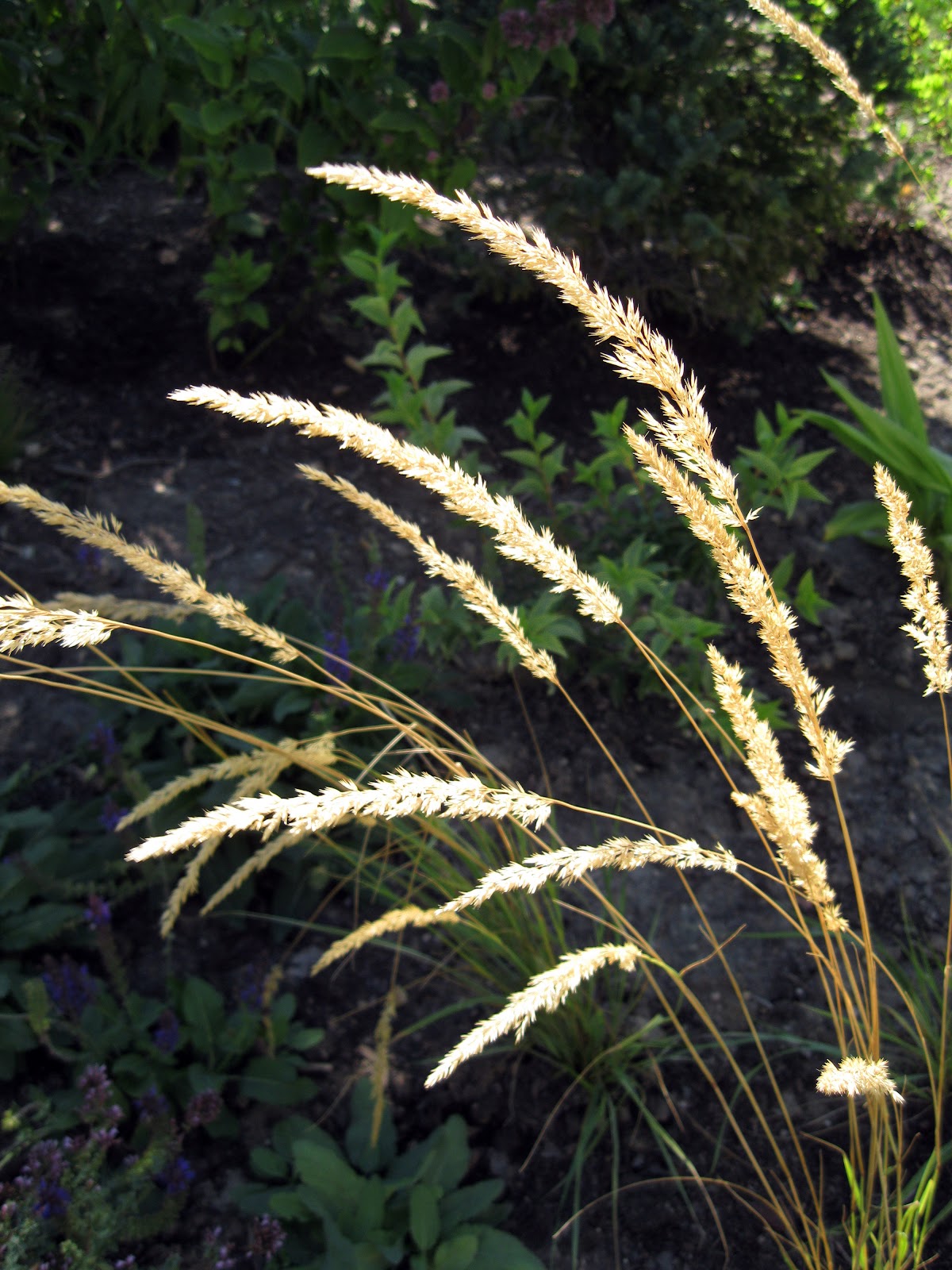 |
| The seed heads of Overdam Feather Reed Grass |
Overdam Feather Reed Grass (Calamagrostis x acutiflora ‘Overdam’) is similar to the Karl Foerster grass that has finally been popping up in public places, like fast-food restaurants, strip malls and gas stations. It’s different in that it is more compact and its leaves are variegated. It’s sterile. I also have a similar grass called Avalanche, which has slightly more green than white in its leaves.
These two grasses and all of the ones listed below are warm season grasses. They really need warm weather before they kick into high gear.
Morning Light Maiden Grass (Miscanthus sinensis ‘Morning Light’) is breathtaking when it is back lit, so be sure to put it in an appropriate location. It has very fine variegated foliage and good winter interest. It can get to be about 4’-6’ but it’s so light and airy that you won’t mind.
 |
| Northwind Switch grass contrasts nicely with the Mohican viburnum behind it. |
Switch grass (Panicum virgatum) is native to the tallgrass prairie, which once covered most of Illinois. I’m particular to the Northwind cultivar but I’m also dying to try Shenandoah, which has more red in it. Switch grass provides great winter interest and is also very good in dried fall arrangements.
 |
| Karley Rose Fountain Grass seed heads sway in the wind |
Karley Rose Fountain Grass (Pennisetum orientale ‘Karley Rose’) and Red Head Fountain Grass (Pennisetum alopecuroides ‘Red Head) have
been interesting. I thought Karley Rose
as only hardy to zone 6 so I planted it near a maple tree in my Zone 5 garden
as an annual. It has been coming back ever since. It has spread somewhat but not obnoxiously so.
I love the swaying of the seed heads, which start out pink and turn a light
beige.
Red Head, on the other hand, has red bottlebrush-type plumes. It's nice but has seeded itself in the garden so it’s currently on probation. I'm hoping that that the spread is due to last year's extraordinarily long, warm fall.
Red Head, on the other hand, has red bottlebrush-type plumes. It's nice but has seeded itself in the garden so it’s currently on probation. I'm hoping that that the spread is due to last year's extraordinarily long, warm fall.
 |
| The seed heads of Tara Prairie Dropseed |
 |
| Prairie dropseed in the garden |
Prairie Dropseed (Sporobolus heterolepsis) adds an incredibly fine texture to the garden. I especially like Tara, which is a bit more upright than the species. It also has a smell this time of year that reminds me of popcorn. My husband can’t smell it, though. I’ve heard this anomaly from more than one person, although I’m not sure why that’s the case.
Of course, there are lots more ornamental grasses available, including several that will take shade or even dry shade. I've recently added Little Bluestem (Schizachyrium scoparium), a butterfly host plant and tallgrass prairie native, so I will have to see how it does.
The deer that occasionally visit my garden never touch the
ornamental grasses – another plus. Care is pretty simple. You just need to chop
them down to about 4-6” high before the growing season starts. They do need to be divided every so often and
the roots go deep so be sure to sharpen your shovel beforehand.
If you’ve never tried ornamental grasses in your garden, I
hope you’ll give them a try. Who know? Maybe you’ll move into category #1 as
well.
By Karen Geisler
By Karen Geisler

