Showing posts with label general gardening. Show all posts

Wednesday, June 5, 2013

Speed Date Confessions


Before I begin blogging I must take a minute to thank and tip my hat to my predecessor, Karen Geisler, who has put her horticultural heart and soul into The Hortiholic from Day One. Job well done, Karen. Thank you for setting the bar so high.

Somehow, this first blog feels like a speed date. You’ve seen those structured date-athons where women get a seat at a small table, usually in a restaurant, with one empty seat on the opposite side. The starter calls time and the men take a seat. Everyone has three minutes to share their assets before time is called and the men move to the next seat and the next potential match. Ah, romance.


So, here goes. I’m an only child who started gardening when my family moved to Champaign, Ill. One summer day I was bored, and decided to talk to the neighbor lady as I saw her head out to her flower garden, shovel in hand. She promptly told 9-year-old me that I wasn’t going to sit and talk while she was working, so I’d darned well better pick up a hoe and get on those weeds. I didn’t know then how that 30-second conversation would change the course of my life, but did it ever. Maybe the Universe does send us what we need?

Within two weeks, I convinced Dad that sod wasn’t a virtue and commandeered a 7 by 12 foot parcel of lawn. By 16, I was working at a garden center every weekend and summers. During my second semester of freshman year at the University of Illinois, I came to my senses and transferred out of Pre-Vet. That’s when my future came into focus. I graduated seven semesters later with a bachelor’s degree in ornamental horticulture. With the exception of a six month stint at Ball Seed Company as azalea buyer, my last 47 years have been spent learning from my garden center customers, first in central Illinois and now at Chalet, in the Chicago North Shore suburb of Wilmette,Ill.

 I’m fortunate to have six-tenths of an acre that has been mine for 24 years. When you collect “woodies”, you can only plant so much before you have to either remove and replant the newest, rarest cultivar, or live with what you have. My passion is anything beech, especially the cultivars of European Beech (Fagus sylvatica). I have 19 as of this minute. Perennials on the other hand are like jello -- there’s always room for more. Since I’d rather be in the garden than in the kitchen, I’ll readily admit to more interest and expertise in ornamentals than edibles.

What do you mean, the time’s up? I haven’t even shared my astrological sign yet.

Sunday, November 18, 2012

A Fall Bouquet


The last flower has faded. All the leaves have fallen from the trees. And the frost has been on more than just the pumpkins.

It's time once again for the final fall bouquet.

This has become an annual tradition for me. I'm the only member of my immediate family who doesn't live in our hometown, so I always spend Thanksgiving at the house of a relative. I usually make this bouquet as sort of a host/hostess gift using dried materials from my garden.

(Of course, there have been several years when I've forgotten the arrangement in my rush to get out the door, but I try to tell myself it's the thought that counts.)

Finding good quality materials in the garden wasn't as easy this year, courtesy of the drought. I started with the old standbys --  hydrangeas, switchgrass (Panicum virgatum 'Northwind'), coneflowers (Echinacea ssp.) and Culver's Root (Veronicastrum virginicum). I threw in some seed pods from sweet coneflower (Rudbeckia 'Henry Eilers') and some cattails cut from a roadside ditch.

Then I added some dried Queen Anne's Lace. Yes, the same wildflower/weed that spread rampantly in my garden, causing countless hours of back-breaking labor. It does look nice dried, however, with its starburst-like seedheads. Anyway, I figured it was pay-back time.

Finding some color proved to be my biggest problem. With last year's warm, extended fall, I could use some brightly colored leaves from my trees and shrubs. Not this time. The only bit of color I could find was a slight red lingering on my sedum's seedheads. I quickly snapped those up.

Eventually, I decided to bite the bullet and visit a craft store where I bought some dried yellow flowers plus some seed pods with a slight lavender tinge. Pricey, but definitely worth it.

So there you have it. I hope you'll try making your own version. You don't need anything fancy. I used a Mason jar filled halfway with river rock to hold all the stems upright. A bit of raffia tied in a bow added a final touch.

Don't sweat the details. After all, this bouquet will be fleeting, one that will quickly give way to holiday greens. It is, however, a good way to share some of your garden's bounty with your family on a special day.

Here's wishing you all a very happy Thanksgiving!

By Karen Geisler

Tuesday, October 23, 2012

The Ghoulish Garden

Mums, Obsidian heuchera and orange pansies

 
Is Halloween your favorite holiday? Worn out your copy of the "Little Shop of Horrors?" Then you may need a ghoulish garden.

Ask yourself, what would Morticia plant? Lily Munster? Or Elvira, Mistress of the Dark? Surely not anything ordinary, something cheery like daisies. No, any of these witchy women would brew up something wonderfully wicked.

Caroline Jones as Morticia
Photo: Gregg's Shock Theater


The most obvious choice is one with bite -- a carnivorous plant like a Venus fly trap.

Who can forget Audrey II in the "Little Shop of Horrors" yelling “Feed Me"?  Or Morticia’s special relationship with her “African Strangler,” Cleopatra?

Unfortunately, these along with a number of other plants like Dracula orchid, Voodoo Lily (Amorphophallus) and Bat Flower (Tacca chantrieri) can't survive Chicago winters outside. But there are lots of other ways to spook-ify your garden.
  
Thankfully, black seems to be the “in” color lately when it comes to flowers.  There are now black pansies, tulips, coral bells, hollyhocks, iris, dahlias and petunias -- just to name a few.

Well, they’re actually more of a deep purple or deep red for the most part, but why be picky?  They are the closest plant breeders have come so far and a lot depends on the light in which they are viewed.

Using black in the landscape can be a bit tricky although it’s a treat when done right. You need some contrast so the black doesn’t just fade into the background. White or gray foliage – think full moon -- generally works well in that regard.

Try Ghost Japanese painted fern (Athyrium 'Ghost') with its silver foliage or a Ghost hosta if you have some shade. Artemisia, sometimes called wormwood, is good in full sun. For a punch of color, add something like Orange Meadowbrite ™ coneflower (Echinacea ‘Art’s Pride’) or Blackberry Lily (Belamcanda chinensis) which has great seed pods in the fall.

 
Bela Lugosi daylily
Bela Lugosi daylily

If you’d like a more varied palette, there are a number of haunted hemerocallis. Bela Lugosi daylily has a special place in my garden, for instance, because of my husband’s love of horror movies. There’s even a Lily Munster daylily. (For a more complete list, visit The Haunted Gardens blog by clicking here.)


Black and orange pansies
Orange and black pansies are a classic.

You could take a cue from Gomez Addams, Morticia's husband, who grew roses (for the thorns), hemlock and hen’s bane (for their toxicity) and poison ivy.  My advice though, is to stick with something like witchhazel (Hamamelis ssp.) for its brilliant fall colors or Ghost ™ weigela (Weigela florida  'Carlton') which has foliage that starts out green and turns a butter yellow as the season progresses. Both are pretty and won’t get you in as much trouble with the neighbors.
 
Of course, the biggest problem with a ghoulish garden is that the Midwest's weather is so unpredictable around Halloween. Your best bet may be orange and black pansies as they can take some cold temperatures.

In the photo above, I used them with Graceful Grasses® Vertigo® pearl millet (Pennisetum purpureum) (named after the famous Alfred Hitchcock thriller no doubt) and some 'Bronzilla' sedge (Carex flagelifera). Obsidian coral bells, the blackest Heuchera, is shown in the container at the very top. You also could add some pumpkins or dead branches with spider webs just before the Big Night.
 
If you need something even spookier, consider a gargoyle or mythical winged creature of some sort. Still want more? I've actually spotted several zombie garden gnomes on the Web. You can't get much more horrific than that.
 

By Karen Geisler

Sunday, September 23, 2012

Dahlias


'Just Peachy' by Fred Brill of Mount Prospect, IL

The dahlias were dazzling this weekend at the Chicago Botanic Garden.

The Central States Dahlia Society hosted its annual show in the Regenstein Building while just outside, in the Circle Garden, dahlias mingled with zinnias, grasses and black-eyed Susans to form perfect fall vignettes.

I have to admit I've rarely grown dahlias. They tend to be high maintenance, requiring a lot of fertilizer. They also prefer to be dug up every fall and stored over the winter.


Dahlia Mingus Phillips II
Mingus Phillip II by Ed Zych of Buffalo Grove, IL.
Most Perfect AA Bloom, Section A

But after seeing the show this weekend, I may have to reconsider. I never realized there were so many different dahlia forms. Sizes range from 1 1/4 inch in diameter to a whopping 12-14". For exhibition purposes, they are divided into 12 groupings based on flower shape, number of petals and size.

Dahlias are mostly grown from tubers or fleshy roots, although they can be grown from rooted cuttings or seeds, according to a handout from the Central States Dalia Society. They love full sun, good air circulation and good drainage. Dahlias generally bloom from early August until frost.


Dahlia Honeymoon
Honeymoon by Axel and Nancy Joob of Wilmette
 
 
Dahlia Midnight Star
Midnight Star by Steve Kuiper of Goshen, IN
3 Most Perfect Orchid Type Blooms
 
Pom Dahlia Tiny
Tiny (close up) by Jerry and Ruth Ann Wittrig of Goshen, IN
3 Most Perfect Pom Type Blooms, Section H, Class H3
 
 
Dahlia April Heather
April Heather by Robert Williamson of Madison, WI
 
 
Dahlia Zorro
Zorro by Jerry and Ruth Ann Wittrig of Goshen, IN
Most Perfect AA Bloom, Section D


dahlia Mingus Gregory
Mingus Gregory by Tom Krewenka
Largest Bloom, Section W


Best of Show Central States Dahlia Society
The Best of Show

For those venturing out into the bright sunny afternoon, there were more dahlias waiting in the Circle Garden.

Dahlia 'Merlot' stood out beautifully again yellow foliage of Gay's Delight coleus (Solenostemon scutellarioides 'Gay's Delight').

Dahlia Prince Charming played well with Ageratum houstonianum 'Diamond Blue' and Sedum rupestre 'Lemon Coral.'

Dahlia Heartthrob mingled with Bidens ferulifolia 'Bidcontis' and Carex testacea 'Prairie Fire.'


Dahlia Heartthrob
Heartthrob


Surrounding the central fountain was a mix of Dahlia 'Zachary Roberts' and Zinnia elegans 'Polar Bear.' It was set off by castor bean (Ricinus communis 'Carmencita Bright Red'), red pentas (Penta lanceolata 'Starla Red') and Salvia coccinea 'Snow Nymph' with a bit of Swedish ivy (Plectranthus coleoides) thrown in for good measure.

Everything glowed in the light of autumn's first full day. It was wonderful way to spend a sunny -- if slightly chilly -- Sunday afternoon.

By Karen Geisler


Dahlia Prince Charming
Prince Charming
Dahlia Zachary Roberts
Zachary Roberts
Dahlia Merlot
Merlot

By Karen Geisler

Wednesday, September 5, 2012

The Power of Rain

Dark rain clouds


Today was a good day. It rained.

Not the light drizzle we’ve had occasionally this summer but a drenching, close-all-the-windows-and-cancel-the-car-wash kind of rain. The sort that makes you want to grab an umbrella, find a lamp post and do your best Gene Kelly imitation.

Gene Kelly in Singin’ in the Rain (1952)
Credit: MGM/The Kobal Collection
You can water and water until the nozzle of your hose seems like it has become a permanent part of your hand, but there’s nothing like a really good rain to revive your garden.

Maybe it’s the temporary drop in temperature during a storm or the higher humidity that inevitably follows. Maybe it's the lightning strikes that fix nitrogen. 

I suspect it may have something to do with the quality of the water, as rainwater doesn’t have chlorine and other chemicals added by municipalities to keep us humans healthy.

But I don’t want to rehash the old arguments about the merits of tap water versus rainwater in the garden
 
All I know is that I kept my plants alive through the current drought with tap water. They didn’t really start looking decent again, though, until it rained.

Granted, it's not Hurricane Isaac, whose remnants barely grazed the Chicago area. This rain and more forecast later this week, however, are enough to revive my dream that this drought may actually end some day. I guess we can only hope.

Maybe this is Mother Nature's way of teaching us a lesson -- that despite our air conditioned houses, cars and trucks, despite our fancy crop irrigation systems, she's still in control.

While the drought isn't as noisy, flashy or as sudden as a hurricane or tornado, its effects will be felt in the Midwest for a long time to come. It also should give all of us a new appreciation for what the Dust Bowl, which stemmed from an even worse drought, must have been like back in the 1930's.

Remember that old Carpenters song, "Rainy Days and Mondays"?  I used to be like that. Rain was depressing as it meant I couldn't go out in the garden.

Not any more. Rain is now a cause for celebration.

As another song noted, don't it always seem to go that you don’t know what you’ve got until it’s gone.

By Karen Geisler


raindrops Grace smoketree
Traces of rain from a short cloudburst back in July

Sunday, August 12, 2012

A Dry Sense of Humor (and a Giveaway)

Chocolate Chip ajuga melting


It's official. Last month was the hottest July on record nationwide. It wasn't much better here in Chicago but at least we've recently gotten some rain and more moderate temperatures.

Of course the rain hasn't been enough to break the drought. And I'm still expecting those 90-degree days to return. After all, it is still August.

At this point, I could really use a good laugh.

I initially had trouble coming up with any garden-related jokes.  I finally remembered these from when I was a kid:

Why did the tomato turn red? Because it saw the salad dressing.

What runs but never tires? Water.

I recalled the last one when watering my garden one morning for what seems like the umpteenth time this summer. I also stumbled across a couple of new ones when doing some (ahem) research for this article.

What do you call it when worms take over the world?  Global worming.

New gardeners learn by trowel and error.

What gets bigger the more you take away? A hole.

The only new one I've managed to come up with is at the top. All kidding aside, there must be some drought-related garden jokes out there. You know, gallows humor -- garden style.

So to help spark some gardening wit, I'm giving away a DeWit crown trowel and a dibbler. As you can see, the trowel looks a lot like a tulip. Both of these babies are top of the line and carry lifetime warranties. They should be great for planting bulbs this fall or at least dreaming about a new beginning next spring.

I'm also throwing in a copy of the Timber Press Pocket Guide to Bulbs by John Bryan.


You only need to comment below for a chance to win, but garden-related jokes, rhymes, riddles, etc. are appreciated.  No dirty jokes, although jokes about dirt/soil are allowed.

The deadline is midnight August 19, 2012, with the winner chosen at random. One entry per person please. Employees of Chalet Nursery and their immediate families are not eligible to win.  Void where prohibited by law.

I’d especially like someone to complete this joke: “Two slugs walk into a bar…..”

By Karen Geisler

Monday, June 25, 2012

Requiem for a Hoe


It’s been a sad week in the garden -- not because of the near-drought conditions or the number of weeds that remain.  It’s because I’ve lost my constant gardening companion for the past 15 years – my Dutch hand hoe.

This was the first good garden tool I ever bought  --  a splurge at the time, but one that proved to be worth it. This hoe lasted through three gardens in three different cities. Sun, shade, you name it, this little tool was great for tackling whatever needed doing.

Sure, I had lost it more times than I’d care to admit – in piles of weeds or fallen leaves, behind some empty plastic nursery pots in the garage. I had even left it out in the rain. Somehow I always managed to find it. Every spring, I would use a steel brush to remove the rust and debris from the previous season. Then I’d sharpen the blade and oil it, making it almost good as new.

By now, of course, the metal blade was pitted and I could no longer read the name on the handle. But it had gotten to the point where it felt like a natural extension on my hand, sort of like the way an old shoe feels. Give me this tool, a pruners and a shovel and I was ready to take on any garden task.

My hoe died with its boots on, so to speak. I had just used it to remove grass that was too close to my yellowwood tree. I was chopping up the heavy clay soil left behind when the blade bounced off a clod and bent inward. I nudged it back as I had a hundred times before. On the next stroke, the blade broke off completely.

I was in denial at first. This couldn’t be! It had always survived before. Maybe I could find someone to weld it back together. I laid the pieces on the ground and went inside for a break. My husband found them and threw them away.

Life goes on and the garden needs to be weeded so I’m looking for another hand hoe. I’ll buy a new one, but it will never totally replace the original. You never really forget a good garden tool.

By Karen Geisler

Tuesday, May 22, 2012

Weeds

Weeds in the garden
Dandelions and other weeds in the garden

It’s said that Nature abhors a vacuum. No where is that more apparent this year than in my garden. Every vacant spot has been filled with weeds.

Last year’s long warm fall and this spring’s early arrival helped not only my plants but the weeds as well. A late frost damaged the foliage on several of my shrubs and trees. But the dandelions? Hah! They just laughed and just kept on growing.

I was already behind in my weeding from last year when a job-change and a stretch of 100+ degree days made it impossible to keep up. This year hasn’t been much better. I’ve been diligently weeding for seven straight weekends and I'm just now starting to seeing the light at the end of the tunnel. (Or is that another dandelion?) 

Like many gardeners in this economy, I have the added burden of a vacant house next door. While the lawn is mowed, nothing is done about the weeds. And all the dandelions had just gone to seed the last time it was mowed.  As my house is the first one downwind, I’m expecting another bumper crop later this summer. Any dandelion aficionados out there willing to come and take them away? They’re free to a good home....

Below are my tips for beginning gardeners. Remember, weeds are every gardener’s dirty little secret. We all have ‘em. So let's get out there and fight the good fight!


Tap root from a weed
This is what happens when you don't get
the entire taproot. The weed just regrows.
-- Weed early and weed often. Get out there as soon as the ground is safe to walk on. Leave no stone…er, plant, unturned. Weeds will hide in crevices, under bushes and in dying bulb foliage.

Don’t stop weeding in the fall until everything, and I mean everything in the garden is dead. Weeds can keep growing for a surprisingly long time. Remember, a weed pulled in the fall is one less weed in the spring.

-- Don't let weeds go to seed. If you can’t immediately remove the weed, at least remove the seed pods. Do not left it go to seed. You will regret it. Maybe not today, but soon and for the rest of your garden’s life.

I’ve always been a bit lackadaisical about self seeders and that has come back to haunt me – big time.

Early last year, I left a few of the Queen Anne’s lace that had blown in over the backyard fence. Now, it has seeded itself all over the place, especially in my day lilies and ornamental grasses. Queen Anne's lace may be nice in bouquets but it’s a thug in the garden! And every plant has a deep tap root that is difficult to completely remove.

-- Mulch, mulch and mulch some more. This will help keep weed seeds from getting the light they need to germinate. It also will make it easier to remove those weed seeds that blow in, at least until their roots grow through the mulch.

How much will you need? If you’re comfortable with numbers, multiply the width times the length, to get square feet. Multiply that by the depth of the mulch desired to get cubic feet. (Two to three inches is good for suppressing weeds.) Divide that by 27 to get cubic yards. You can also check out www.mulch-calculator.net.

-- Best organic solution? All of the above. Supposedly boiled vinegar works, but you need to re-apply several times, according to what I’ve found on the Web. My garden is organic but after fighting some particularly nasty weeds for years, I’m seriously considering using Roundup or another herbicide in some spots.

-- Weed after a rain or water before you weed. Those intruders will be easier to pull/pry from wet soil. That’s especially true if you have lots of weeds with tap roots and/or the heavy clay soil so prevalent in the Chicago area.


Weeding tools
My favorite weeding tools

-- Choose your weapons carefully. There are almost as many different types of weeders as there are weeds. Be sure to find one that feels comfortable in your hand. The two of you will become very close over the years.

I mostly rely on something called a Dutch hand hoe, a Hori Hori Japanese knife and a metal rod with a notch at the bottom. There are plenty of alternatives though. (Note: If you are left-handed, there are specialized weeders made for you.)

-- Know your enemy.  Everyone, of course, recognizes dandelions (taraxacum officinale). But do you know your chickweed (stellaria media) from your purslane (portulacea oleracea)? What's the best way to keep them from crowding out your precious perennials? Does it have a tap root?

There are lots of links on the Web that can help you identify and fight the various weeds you'll find in the garden. Check out these from the National Gardening Association and the Weed Science Society of America. The University of Illinois Weed Science program has an extensive database as well. And here's a good photo gallery from Michigan State University. Want to focus on just the top 10? Mother Earth News surveyed gardeners nationwide and published the results here last year.

Do you have any tips on weed control in the garden? Does vinegar actually work? Any other organic methods you would recommend? Your comments and suggestions are appreciated.

By Karen Geisler

Monday, March 12, 2012

Hort Couture: Chicago Flower & Garden Show

A flower mannequin at the Chicago Flower and Garden Show

The Chicago Flower and Garden Show, being held at Navy Pier now through March 18, is celebrating flowers and fashion with this year's theme, "Hort Couture."

In addition to the many show gardens, there were several fashion-forward displays as a result.

The Chicago Park District's display

Of course, there are lots and lots of spring bulbs. The perfume of the tulips and hyacinths permeates whole sections of Navy Pier.
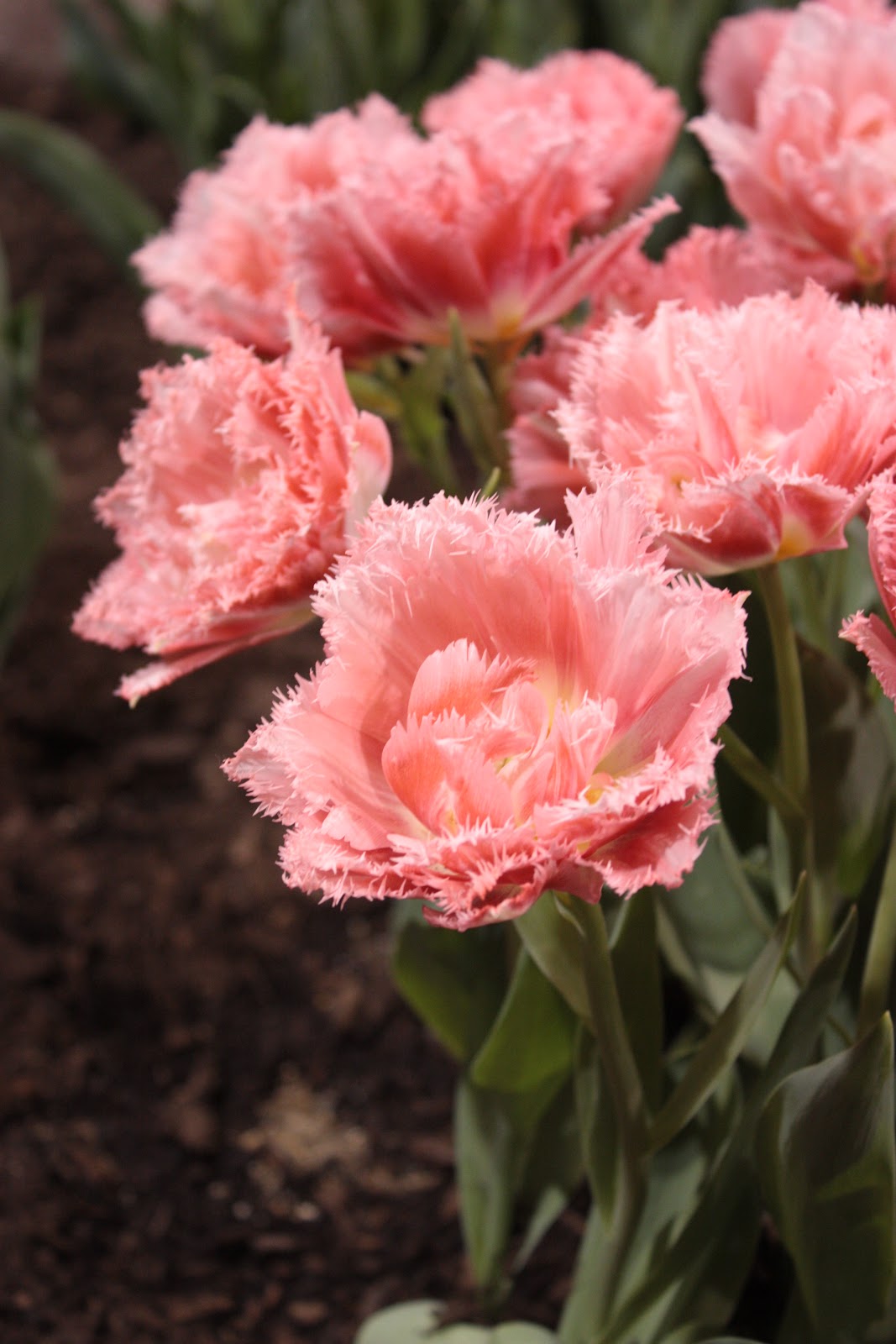
A fringed tulip

A double tulip

Mango tulips


Tulips and hyacinths, a very fragrant combination


There are also many great tablescapes.....


Plus there are two very special gardens -- one built to resemble the "Let's Move" kitchen garden outside the White House....


And another honoring the long-running NBC daytime drama, "The Days of Our Lives." It includes original props from the show plus the wedding gowns from four of the show's weddings.


One of the most breathtaking features is right at the entrance, a giant agapanthus sculpture by Britain's Jenny Pickford, a blacksmith and glassblower.


Back by a giant green wall, the 14' tall sculpture of forged steel and glass towers over visitors. It is 11 feet wide and weighs 1,100 pounds.


Show hours are from 10 a.m. to 8 p.m. Monday through Saturday, and from 10 a.m. to 6 p.m. Sunday. Admission prices vary from $15 to $19 for adults, depending on whether tickets are bought online or at the box office and whether they are for a weekday or weekend. Children ages 4 to 12 are $5 apiece.
 
By Karen Geisler

Tuesday, February 7, 2012

A Winter Walk in the Lurie Garden

Chicago skyline Lurie Garden winter
The Chicago skyline from the Lurie Garden
The Lurie Garden, with its New Wave mix of native perennials and ornamental grasses, is a popular attraction on Chicago's lakefront. About 1 million visitors ramble its paths annually. You'll see very few of them in February, though, due to the Windy City's often brutal and unpredictable winters.

This year has been different, with temperatures that have seemed downright balmy, so I decided to take a guided walk offered by the garden this past weekend. While the views might have been improved with a touch of snow or frost, there was still plenty to take in.
 

Wild quinine winter Lurie Garden
Wild quinine

Colors ranged from the grey of mountain mint to the red of Moorhexe moor grass to the light tan of prairie dropseed. They were punctuated throughout by the spiky seedheads of cone flowers and rattlesnake master. And when the wind blew, the dried leaves of the European beech trees and the Northern sea oat grasses rustled softly.


Rattlesnake master Russian sage Lurie Garden winter
Rattlesnake master intertwined with Russian sage
All of this is framed by the Chicago skyline, the Art Institute’s Modern Wing and Lake Michigan. Yet, thanks to its “Shoulders” -- a large hedge of arborvitae, beech and hornbeam-- the site is peaceful and serene. It's a welcome retreat from the hustle and bustle of everyday life as well as the rest of Millenium Park.


Culver's Root winter Lurie Garden
Culver's root


Allium foliage winter Lurie Garden
Ornamental onion  'Summer Beauty'

There are "communities" here as the various plants intermingle and weave a tapestry of sorts. Some of the subleties now apparent in planting plan by Dutch designer Piet Oudolf actually may have been lost in the snow most winters.


Bottle gentian Russian sage Lurie Garden winter
Bottle gentian, Russian sage and Culver's root
Horticulturalist Laura Young, who led Saturday's walk, said the garden is being effected by this year’s warmer-than-usual temperatures. The Lenten roses, for example, have already bloomed -- a couple of months ahead of schedule.  The chickweed (unfortunately) is doing well and needs to be pulled.

The garden, usually mowed during the first week of March, also may get its annual haircut a bit earlier this year as a result. So if you want to see the winter garden in all its glory, you probably should go sooner rather than later.  I hope it will inspire you, as it did me, to add more winter interest to your garden this summer using native plants.
 

Rattlesnake master winter Lurie Garden
Rattlesnake master silhouetted by the
Modern Wing of the Art Institute
Winter north view Lurie Garden
The view to the north

Latin names:
Arborvitae                    Thuja occidentalis
Beech, European         Fagus sylvatica
Bottle gentian              Gentiana andrewsii
Cone flower                 Echinacea
Culver's root                Veronicastrum virginicum
Hornbeam                   Carpinus betulus
Lenten rose                  Helleborus orientalis
Moor grass                   Molina caerulea
Mountain mint            Pycnanthemum muticum
Northern sea oats        Chasmanthium latifolium
Ornamental onion      Allium lusitanicum syn A. 'Summer Beauty'
Prairie dropseed           Sporobolis heterolepsis
Rattlesnake master      Eryngium yuccifolium
Russian sage                Perovskia atriplicifolia
Wild quinine                Parthenium integrifolium

For a complete list of plants in the Lurie Garden, click here.

By Karen Geisler
Related Posts Plugin for WordPress, Blogger...

Share: