Showing posts with label echinacea. Show all posts

Sunday, August 19, 2012

A Second Wind

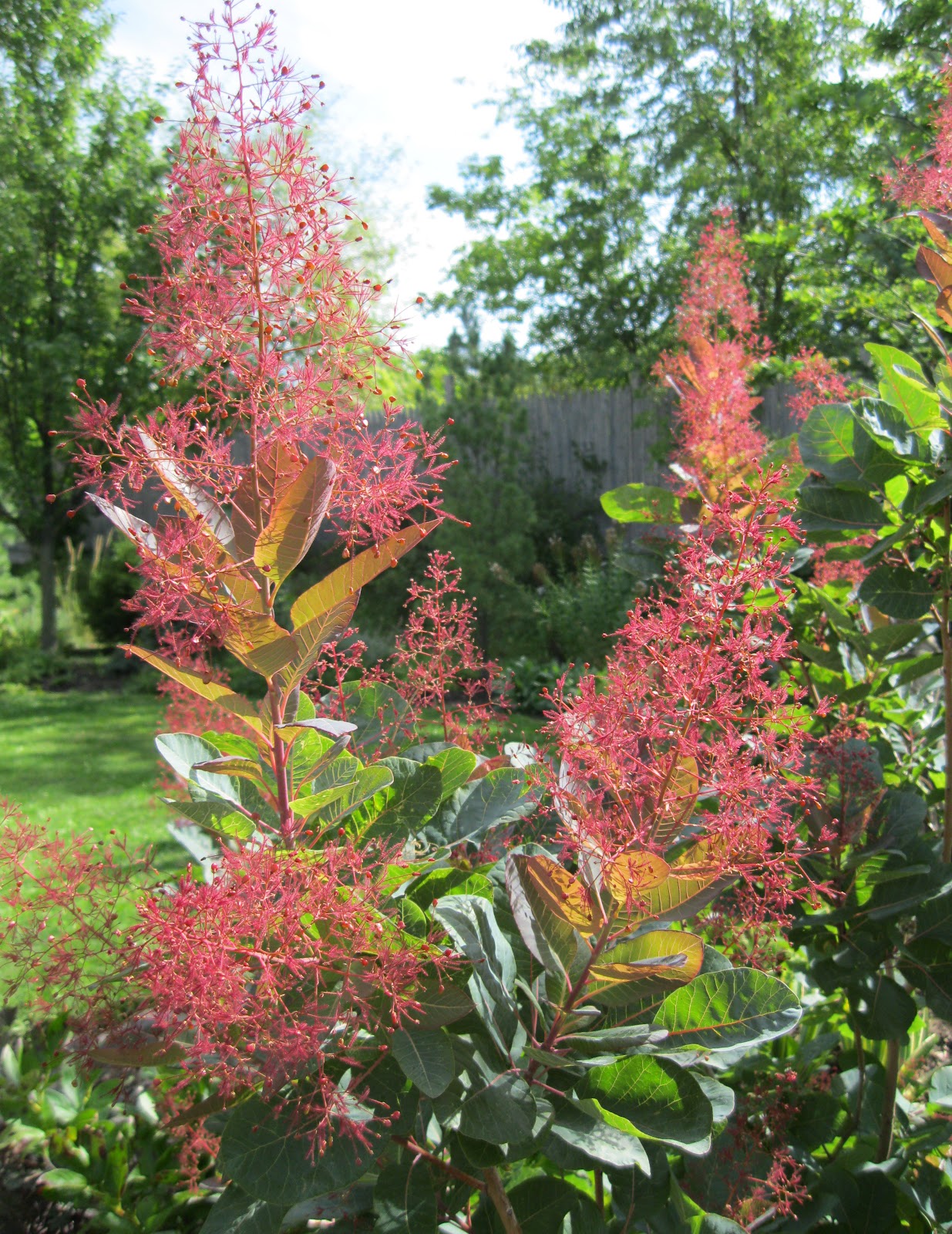
Grace smoketree
Grace smoke tree


Something strange is happening in my garden.

The Pixie Meadowbrite® coneflowers are blooming again, although at a much lower height than the seedheads.  Ditto for two daylilies, Happy Returns and Jedi Dot Pierce, whose flowers are almost lost in the foliage.

I'm also getting sporadic blooms from my Frosted Violet heuchera, Firewitch dianthus and anemone sylvestris. Three Purple Rain salvia transplanted at the height of the drought are actually throwing some flowers. And my Grace smoke tree is finally blooming, much later than ever before.

Cooler temperatures in the past two weeks have worked their magic. There also has been some rain -- only about an inch so far this month -- but it is moisture nonetheless. My area remains in severe drought, with extreme drought just 10 miles away.

I guess I shouldn't be surprised at the reduced height of my flowers. A lot of the corn and soybean fields outside Chicago are much shorter than usual this year due to the drought. During a recent visit to the Midewin National Tallgrass Prairie in Joliet, Illinois, much of the restored prairie there was about half its normal height according to my tour guide.

Yes, I will take what I can get. It seems my plants are finally getting a second wind, doing a happy dance like Snoopy, giving me a sign that they're doing okay so far and will be ready to roll again next spring.

Now if I can only get all those pesky, heat-loving, water-stealing weeds out of my garden beds.....
 
By Karen Geisler

Jedi Dot Pierce daylily


Pixie Meadowbrite coneflower
Pixie Meadowbrite® coneflower


By Karen Geisler

Monday, July 23, 2012

Jim Ault's Last Coneflower

Burgundy Fireworks coneflower

The new Burgundy Fireworks coneflower is striking with its quilled petals and deep red stems. It’s the latest introduction by Jim Ault at the Chicago Botanic Garden who helped kick off the coneflower color revolution. It also will be his last coneflower selection.

Ault has decided its time to move on. The world of coneflowers has changed a lot since his Orange Meadowbrite™ coneflower (Echinacea ‘Art’s Pride’ PP #10050) first hit the market in 2004. It was the first orange coneflower in cultivation.

Until then, this native plant had been just plain purple. It now comes in orange, peach, white, yellow, gold, magenta, pink and light green as well as various combinations of those colors. There are dwarf and double flowering varieties and even one called "Double Decker."

“Who would have ever guessed that we would see so much progress in breeding this crop say even five years ago?” Ault wrote in an email about his decision. “The progress in developing novel forms has been stunning.”

He also noted coneflowers are being developed by many people at this point.

“I am honored to have ‘been there’ at the beginning of the new trend in coneflower breeding but I cannot compete directly with the resources of the large breeding programs in terms of staffing, space to grow out plants, etc.” Ault wrote.

Jim Ault
Jim Ault
He's definitely going out with a bang. Burgundy Fireworks (Echinacea ‘Burgundy Fireworks’ PPAF) has upturned, beet-red petals that are fused into quills. The deep red color of its stems is more prevalent in the spring and fall but can also be seen in the summer. The leaves get red midveins in cold weather.

It took ten years to develop and combines three different coneflowers: Echinacea laevigata, E. purpurea and E. tennesseensis.

Burgundy Fireworks is hardy in zones 5 to 7 and grows to about 18” tall by 24” wide. Like Ault’s other coneflowers, it is a Meadowbrite™ introduction through Chicagoland Grows®, Inc.

Ault said the Chicago Botanic Garden will continue to evaluate coneflowers though its program run by Richard Hawke. He also expressed concern about Aster yellows, a plant disease that can strike coneflowers.  

“As we grow more coneflowers, the potential is there for Aster yellows to become even more prevalent,” he wrote.

There is no cure for Aster yellows. Once a coneflower is infected, the plant has to be removed and destroyed. Ault estimated that in a bad year, he has lost up to 5% to 10% of his coneflowers to Aster yellows.

“Breeding for resistance may be a solution, but I’m not sure anyone has a clear understanding of which selections are more resistant,” he wrote. He said as gardeners become more educated about Aster yellows, they hopefully will know the symptoms and can remove infected plants from their gardens.

What’s next for Ault? He definitely will be adding more cultivars of Baptisia australis, a native plant commonly known as False Indigo, to his Prairieblues™ series. Ault currently has eight new varieties in nursery trials, with the first expected to be introduced in 2014. He also is developing new phlox cultivars, which may be available in 2013 or 2014.

Ault added that there are some other things he’s working on but he isn’t ready to talk about them just yet.

“Can’t tip my hand to the competition,” he said.

By Karen Geisler


Burgundy Fireworks coneflower landscape
Burgundy Fireworks coneflowers in the landscape
Photo by Chicagoland Grows ™ Inc.

Wednesday, July 11, 2012

Summer Beauty


Allium Summer Beauty flowers
Allium 'Summer Beauty'

My Happy Returns aren’t happy. The Russian sage is threatening to defect. And my Bloodgood is screaming bloody murder.

Watering restrictions are everywhere in the Chicago area, courtesy of the drought and record-high temperatures. All this has taken a heavy toll on my garden.

I don’t know what I would do without Summer Beauty -- the ornamental onion that is.

This is one allium that definitely lives up to it name.  Its 1 ½-inch light pink balls are just starting to burst into bloom.  The color goes with everything. And unlike many alliums, this one keeps its strappy dark green foliage for the entire growing season instead of fading away once the flowers are finished. It even looks good once the blooms have faded (think star burst) so I leave them up for the winter.

Allium Summer Beauty flower closeup


Summer Beauty, which gets about 16” to 18” high and wide, is definitely drought tolerant. I think I have watered it only once so far this year, although it probably helps that I have it in a lightly shaded area.

It multiplies through rhizomes but not obnoxiously so. It’s just enough so you can divide them in the spring every few years and spread Summer Beauty around the garden.

Did I mention that it’s deer and rabbit resistant? Hardy in Zones 4 to 8? What more can a gardener ask for?

Summer Beauty is especially welcome this year as the only plants still blooming in my garden after our hotter-than-Hades weather are mostly cone flowers and dayliles.

Below are a few pictures from what probably is my garden’s last hurrah for this growing season.  I do have some fall bloomers – asters and sedum mostly – although I’m not sure how they will fare in this heat with limited watering. For now, I’m mostly concentrating on my trees and shrubs, which would be a lot harder to replace than perennials.

So enjoy these summer beauties (small s, small b). And stay cool!
(If you'd like to read about another allium, click here for an earlier post about the circle onion.)

(Plants referred to in the first paragraph are Hemerocallis x 'Happy Returns,' Perovskia atriplicifolia and Acer palmatum 'Bloodgood.')

Cone flowers
Cone flowers (Echinacea)


Burnet
Burnet (Sanguisorba menziesii)


Lavender Deal daylily
Lavender Deal daylily (Hemerocallis)

By Karen Geisler

Friday, September 16, 2011

From Soup to Nuts


Now Cheesier echinacea
Now Cheesier echinacea

Have you ever noticed how many of the newer perennials have food-inspired names?

Several of the latest coral bells or heuchera have yummy-sounding titles as do many new coneflowers or echinacea. In fact, you could make a whole “meal” with them if you toss in a few old standbys.


Guacamole hosta
Guacamole hosta
For starters, there’s Guacamole (hosta). First course: Tomato Soup (echinacea). Follow that with Mac 'N Cheese (echinacea) or maybe Now Cheesier (echinacea). Have some Fried Green Tomatoes (hosta) on the side.

Want something to drink? There’s Spilt Milk (hosta), Spilled Milk (pulmonaria), Bowl of Cream (peony) and Milkshake (echinacea). You also could enjoy Coconut Lime (echinacea) or Sweet Tea (heucherella).

If you'd prefer something stronger, there's Merlot (echinacea), Blackberry Wine (corydalis), Raspberry Wine (monarda) or Peppermint Schnapps (hibiscus).

Lemon Queen helianthus
Need some fruit to cleanse your palate? Check out Hot Papaya (echinacea), Lemon Queen (helianthus) or Tangerine Dream (echinacea).

If you still have room for dessert, there are plenty of sweets: Crème Brulee (heuchera), Plum Pudding (heuchera), Key Lime (heuchera), Caramel (heuchera), Peach Flambe (heuchera), Chocolate Chip (ajuga), Cotton Candy (stachys) and Raspberry Sundae (peony), just to name a few.

And then there’s chocolate -- lovely, delightful chocolate, good for whatever ails you. You could build a whole garden around plants with chocolate in their names. Two of the best are Chocolate Ruffles (heuchera) and Chocolate Joe Pye Weed (eupatorium).

If you'd prefer something lighter, try Pistache (heuchera), named for the tree that produces pistachio nuts.


Pistache heuchera
Pistache heuchera
Ironically, and perhaps thankfully, none of these perennials with food-inspired titles smell like their namesakes. The only plant I’ve ever found that even remotely smells like food is an ornamental grass called prairie dropseed or sporobolus heterolepsis. Its plumes smell like hot buttered popcorn to me on a good day although my husband can’t smell it at all.

The trend toward food-related perennial names is a bit puzzling, as you don’t see many such names much among annuals, trees or shrubs. The only candidates that come to mind are Chocolate cosmos and Popcorn doublefile viburnum.

Maybe it’s because developing new hybrid plants is a lot like cooking – take a cup of Plant A, add a dash of Plant B, put them together in a warm environment and … well, you get the picture. At least putting these food-inspired plants in your garden won’t pack on the extra pounds the way the real thing would.

All this, however, does leave me wondering what's next. At this rate, it probably won’t be long until someone comes up with a plant named PB&J. Just remember you heard it here first.

(With photos by Lynn Dipple)

By Karen Geisler
Related Posts Plugin for WordPress, Blogger...

Share: