Showing posts with label Piet Oudolf. Show all posts

Saturday, November 10, 2012

To Cut, or Not to Cut


To cut, or not to cut: that is the question:
Whether ‘tis nobler in the garden to suffer
The stalks and seedheads of outrageous foliage,
Or to take pruners against a sea of dead leaves
And by cutting end them?

 -- With apologies to William Shakespeare

Hamlet’s got nothing on me, at least when it comes to cutting back the garden each fall. I’m always of two minds.

Should I leave the foliage of my perennials and ornamental grasses up all winter? Or should I cut them all down?

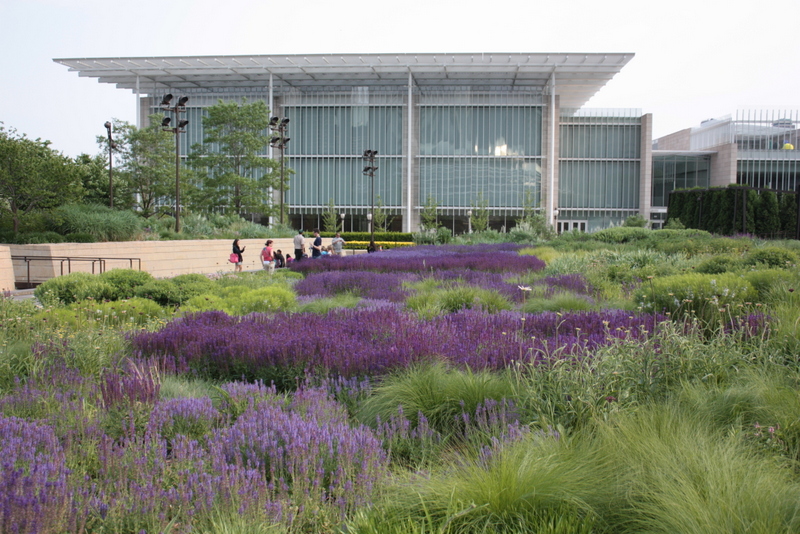
I fell in love with the look of seedheads and ornamental grasses in winter after reading the books of Dutch plantsman Piet Oudolf. The Lurie Garden in downtown Chicago, where he designed the perennial plantings, is an excellent example.

Ornamental  grasses along with my evergreens provide some much needed structure in the winter landscape. I also love the way the grass foliage can wave in the wind and cast shadows on the snow.

Seedheads provide food for the birds in the winter. Coneflowers (Echinacea ssp.) especially seem to be popular with my feathered friends. There’s generally nothing left on them by the time spring arrives even though I regularly stock two bird feeders.

Coneflower seedheads in the winter garden

The foliage can provide shelter to birds and other living creatures as the cold weather finally arrives. In addition, it insulates the crowns on plants I’ve added in the past season. The survival rate in my garden has definitely improved by waiting until spring to cut everything down to the ground.

With this year’s drought, though, the question of whether to cut is proving to be more problematic than usual. The remains of my peonies, for example, don’t look good – with black spots over large portions. I’m going to cut them off and bag them, just in case it’s due to a disease or fungus. Leaving them up would only compound any problem.

I'm also thinking about pruning everything around my bulbs and spring bloomers. Because the weather got so warm so early last spring, I didn't get a chance to cut down the clutter around them until they were already up and growing fast. Spring clean up was much more difficult than usual as a result.

I know that my catmint (Nepeta x faassenii  'Walker's Low), a sprawler if ever there was one, could easily stand one more "haircut" this year. Ditto for my daylilies.

Prairie dropseed foliage in the winter garden

Then there’s the question of my soil. Although I put lots of compost in my clay soil initially, I haven’t done it for a few years now. Boy, could you tell during the drought this last summer. Some newer beds especially fared poorly.

My garden obviously needs more organic matter and fall is a good time to do it. That way, the compost or other material can break down over the winter, just in time to provide nutrients to my plants in the spring. Besides, spring usually is too wet to work with clay soil. (At least I can hope that will be the case after this year's drought.)

Amending the soil will be difficult unless I cut down most, if not all of the foliage in some areas. At this point, I’m waiting for a soil sample to come back before making a decision. It might be a case where, as Hamlet said, I must be cruel only to be kind.

I've been lucky so far because the weather has turned a bit warmer, allowing me to hold off making a decision. I 'd like to do something before the snow flies, which probably won’t be long now. Let’s just hope it doesn't turn out to be, as another Shakespeare character once noted, the winter of our discontent.

By Karen Geisler

Wednesday, October 31, 2012

The Lurie Garden in Fall

Toad lillies in the Lurie Garden
Toad lilies in the Lurie Garden

The greens of summer have faded at the Lurie Garden in downtown Chicago, replaced by splashes of yellow, gold and various shades of brown. Yet, despite the shorter days and near-freezing temperatures at night, there's still plenty to see.

The toad lilies (Tricyrtis 'Tojen'), with their delicate spotted orchid-like flowers, are a delight. You'll also find Japanese anemones (Anemone hupehensis 'Praecox') backed by goldenrod (Solidago 'Fireworks') along the garden's easternmost edge.

And what would any respectable garden be without a few purple asters? There's the tatarian aster (Aster tartaricus 'Jindai') reaching for the skies and the much lower 'October Skies' (Symphyotrichum oblongifolium).


Asters in the Lurie Garden

Over on the other side of the boardwalk, several plants are sporadically reblooming – including the salvia that creates the garden’s famous “River” in early summer. A few coneflowers (Echinacea ssp.) can be found hiding here and there. Hyssop (Agastache rupestris) and calamint (Calamintha nepeta var. nepeta) have fewer flowers than at the height of summer but still look pretty good.

You'll also see some unusual seedheads popping up everywhere in the calamint. According to the garden's horticulturalist, Laura Ekasetya, these are bottle gentian (Gentiana andrewsii), a native Illinois prairie plant.


Bottle Gentian
Bottle gentian seedheads in the calamint

Bottle gentian generally blooms a brilliant blue in late September, although it was a month early this year, she reported. This plant is unusual in that it takes seven years to go from seed to bloom. Now that the garden is in its eighth year, visitors will be seeing more bottle gentian in the future.

Of course, the garden's ornamental grasses are in their full glory, seed heads waving proudly in the wind off nearby Lake Michigan. The northern sea oats (Chasmanthium latifolium) especially rustle in a stiff breeze. These will eventually come to dominate the garden during the winter, but for now they are content to bide their time.

The amount of life still left in this garden surprised me last weekend. My suburban Zone 5 garden is all but finished for the season. If I needed any reminder that downtown Chicago was switched to Zone 6 in the recent revision of the USDA's plant hardiness map, I certainly got it.
 
I have now visited and photographed this garden, designed by famed Dutch plantsman Piet Oudolf and built over a parking garage, in all four seasons. It's been amazing each time. I'm always impressed by how a garden of this size and beauty is maintained with no chemicals using mostly volunteer labor. It shows no ill effects from this year's drought.

You hear a lot about sustainability these days. This garden is living proof it can be done. It gives me something to aspire to in my own, much more modest garden.

To see the Lurie Garden in other seasons, please click on one of the links below.

                             Winter                 Spring               Summer


By Karen Geisler

Lurie Garden in fall with amsonia


Amsonia allium miscanthus Lurie Garden
Amsonia 'Blue Ice' with Allium 'Summer Beauty' in front and common eulalia grass
 (Miscanthus sinensis 'Malepartus) at left back.

Arkansas bluestar Lurie Garden
Arkansas bluestar


Northern sea oats Lurie Garden
Northern sea oats


Japanese anemone goldenrod Lurie Garden
Japanese anemones with goldenrod in the background


Tuesday, June 5, 2012

Crazy 'bout Kalimeris


One of the longest blooming plants in my garden is probably one you’ve never heard of – Kalimeris incisa ‘Blue Star’ also known as the Blue Star False Aster.

This plant is already covered with 1-inch light purple daisy-like flowers. Most years, it keeps going until the first frost if I give it a good shearing after every flush of flowers.  During last summer, when we had a long stretch of 100-degree days, it was one of the few perennials that kept on pushing out flowers into the fall.

I first stumbled across this plant when researching Piet Oudolf for a garden design class. Oudolf, who helped design the Lurie Garden in downtown Chicago, lists Kalimeris incisa in two of his books, “Planting the Natural Garden” and “Dream Plants for the Natural Garden.”

The latter describes it as “an unpretentious plant which builds into a pleasant cluster of endlessly remontant, lilac-blue daisy flowers. Strong and reliable, it combines well everywhere.” I couldn’t have put it better myself. It resembles a light purple version of boltonia, only shorter and longer blooming, if you’re familiar with that plant.

Kalimeris is not fussy, although it needs watering the first year and prefers well-drained soil. It grows about 18 to 24” tall in full sun or part shade and is hardy in zones 5-9. While it can need some support, the plants seems happy in between other flowers that hold it up without staking. And it can easily be divided after a few years. 

Kalimeris incisa 'Blue Star' and Nepeta x faassenii 'Walker's Low'

In fact, the only thing kalimeris lacks is fragrance. I’ve solved that problem by planting some “Fragrant Returns” day lilies (Hemerocallis) near my main grouping of kalimeris. I'm hoping the light yellow day lilies will complement the yellow center of the kalimeris blooms. Those perky little purple stars already look gorgeous in front of my Walker’s Low catmint (Nepeta x faassenii 'Walker's Low'). In fact, it looks so good that I’ve put off giving the nepeta the first of its three annual shearings for a while.
Kalimeris, a native of China, Japan and Siberia, has been around a long time. It was first mentioned in 1825 and is popular in Europe. One of its cousins, Kalimeris pinnata, was a favorite of Elizabeth Lawrence, the famous southern garden writer. She was definitely a fan of pinnata, a double white False Aster, which she knew as Asteromoea mongolica or the Oxford Orphanage Flower. I would like to add that to my garden as well, but it's only hardy to zone 6.

Who knows? With global warming, I may yet be able to go kalimeris crazy with both varieties.

By Karen Geisler

Wednesday, May 30, 2012

The Salvia River


The Salvia River

The Salvia River is flowing once again in the Lurie Garden.

The crocuses and grape hyacinths of spring have given way to an undulating sea of several different salvia varieties. It stretches for about two-thirds the length of the garden, which lies between the downtown Chicago skyline and Lake Michigan.

This was probably the most photographed garden in Chicago on Memorial Day weekend, with many families, friends and lovers out for a short cruise. The cool blues and purples somehow seemed to make the high heat and humidity a bit more manageable for a time.  Some also enjoyed the water feature that divides the garden in two lengthwise.

Salvia blooming Lurie Garden


There are still bulbs floating here and there although they are now alliums or ornamental onions.  The Star of Persia (allium christophii) is an explosion of purple while the allium atropurpureum provides violet purple dots of color. The dark green leaves of allium 'Summer Beauty' are coming up nicely, with their flowers content to wait for the next wave.
Several other plants have already joined the flood of color. There's Blue Star (amsonia), which provides some light blue. A touch of white, not unlike like the crest of a wave, comes from False Indigo (baptisia), Bowman's root (gillenia trifoliata), Beardtongue (penstamon) and the Great White Fleece Flower (persicaria polymorpha).

To accent all that, there's the pink in Jerusalem sage (phlomis tuberosa ‘Amazone’), Bradbury's bee balm (monarda bradburiana) and Great Masterwort (astrantia major).

Salvia River Lurie Garden
Salvia Lurie Garden Art Institute

The ornamental grasses are just setting sail, although prairie dropseed (sporobolus heterolepsis) is already providing some nice ripples in the landscape.  These grasses will eventually anchor the garden, which was designed by Piet Oudolf, throughout the fall and winter.
For now, though, the Salvia River just keeps rolling along.

To see more pictures of the Lurie Garden in other seasons, see spring and winter.


Salvia at Lurie Garden southwest
The Lurie Garden, looking southwest


Star of Persia allium Lurie Garden
Allium christophii 'Star of Persia'


Allium atropurpureum at Lurie Garden
Allium atropurpureum


Bradbury monarda at Lurie Garden
Monarda bradburiana


Prairie smoke baptisia Lurie Garden
Geum 'Prairie Smoke' in the foreground, white baptisia in the right middle ground
 and the part of the salvia river in the very back.
 
By Karen Geisler

Tuesday, February 7, 2012

A Winter Walk in the Lurie Garden

Chicago skyline Lurie Garden winter
The Chicago skyline from the Lurie Garden
The Lurie Garden, with its New Wave mix of native perennials and ornamental grasses, is a popular attraction on Chicago's lakefront. About 1 million visitors ramble its paths annually. You'll see very few of them in February, though, due to the Windy City's often brutal and unpredictable winters.

This year has been different, with temperatures that have seemed downright balmy, so I decided to take a guided walk offered by the garden this past weekend. While the views might have been improved with a touch of snow or frost, there was still plenty to take in.
 

Wild quinine winter Lurie Garden
Wild quinine

Colors ranged from the grey of mountain mint to the red of Moorhexe moor grass to the light tan of prairie dropseed. They were punctuated throughout by the spiky seedheads of cone flowers and rattlesnake master. And when the wind blew, the dried leaves of the European beech trees and the Northern sea oat grasses rustled softly.


Rattlesnake master Russian sage Lurie Garden winter
Rattlesnake master intertwined with Russian sage
All of this is framed by the Chicago skyline, the Art Institute’s Modern Wing and Lake Michigan. Yet, thanks to its “Shoulders” -- a large hedge of arborvitae, beech and hornbeam-- the site is peaceful and serene. It's a welcome retreat from the hustle and bustle of everyday life as well as the rest of Millenium Park.


Culver's Root winter Lurie Garden
Culver's root


Allium foliage winter Lurie Garden
Ornamental onion  'Summer Beauty'

There are "communities" here as the various plants intermingle and weave a tapestry of sorts. Some of the subleties now apparent in planting plan by Dutch designer Piet Oudolf actually may have been lost in the snow most winters.


Bottle gentian Russian sage Lurie Garden winter
Bottle gentian, Russian sage and Culver's root
Horticulturalist Laura Young, who led Saturday's walk, said the garden is being effected by this year’s warmer-than-usual temperatures. The Lenten roses, for example, have already bloomed -- a couple of months ahead of schedule.  The chickweed (unfortunately) is doing well and needs to be pulled.

The garden, usually mowed during the first week of March, also may get its annual haircut a bit earlier this year as a result. So if you want to see the winter garden in all its glory, you probably should go sooner rather than later.  I hope it will inspire you, as it did me, to add more winter interest to your garden this summer using native plants.
 

Rattlesnake master winter Lurie Garden
Rattlesnake master silhouetted by the
Modern Wing of the Art Institute
Winter north view Lurie Garden
The view to the north

Latin names:
Arborvitae                    Thuja occidentalis
Beech, European         Fagus sylvatica
Bottle gentian              Gentiana andrewsii
Cone flower                 Echinacea
Culver's root                Veronicastrum virginicum
Hornbeam                   Carpinus betulus
Lenten rose                  Helleborus orientalis
Moor grass                   Molina caerulea
Mountain mint            Pycnanthemum muticum
Northern sea oats        Chasmanthium latifolium
Ornamental onion      Allium lusitanicum syn A. 'Summer Beauty'
Prairie dropseed           Sporobolis heterolepsis
Rattlesnake master      Eryngium yuccifolium
Russian sage                Perovskia atriplicifolia
Wild quinine                Parthenium integrifolium

For a complete list of plants in the Lurie Garden, click here.

By Karen Geisler
Related Posts Plugin for WordPress, Blogger...

Share: