Showing posts with label spring. Show all posts

Sunday, March 17, 2013

Hurry Spring!

Red tulips in blue vase
These will be the only blooms in my garden this year on the first day of spring.

T.S. Eliot was wrong. It’s March, not April, that’s the cruelest month, at least for Chicago gardeners.

Some years, winter quietly slips away, allowing crocuses, daffodils and tulips to burst forth in a cacophony of color. Last year was like that, with record high temperatures in the 70s and 80s.
“In like a lion, out like a lamb,” as the old saying goes.
This year, though, the lion came and shows no signs of leaving anytime soon. The first day of spring is just 48 hours away but we have snow on the ground with more forecast tomorrow. Most of my flower beds are frozen solid. Night-time temperatures are expected to dip into the teens later in the week.


Hyacinth and daffodils
The first day of spring 2012 (left) and 2013 (right)


Magnolia blooms and buds
Magnolia blooming 2012, buds only in 2013

We've obviously been spoiled by mild winters the past two years. Waiting for spring seems more like waiting for Godot. What’s a gardener to do?

I’ve mostly been dreaming about what I want to do in the garden this year. Much of it will be damage control. Last summer’s drought killed one arborvitae and damaged two other trees in my garden. My weeping cherry tree also wasn’t looking too good last fall.
Will there be other victims? I’ll just have to wait until everything starts leafing out. I’m especially concerned about the plants I put in last fall. We had some very cold days in the first part of winter with no snow to protect them. I normally would have planted them earlier, giving them more of a fighting chance, but I was too busy doing the weeding that I had put off because of the summer’s high temperatures.
For now, I'm sharpening (and resharpening) my garden tools, buying seeds, looking at plant catalogs and doing some online research.
 
Of course, despite the whacky weather we get in the Midwest, I want it all: loads of color, long bloom times, hardiness, drought tolerance, sustainability and, oh yes, the ability to flourish in compacted clay soil. Is that too much to ask?

Once I make up my mind, though, I'm full of indecision. It always drives my husband and son crazy this time of year.
How are you bidding your time? And what are you planning to add to your garden this year? Milkweed and rudbeckia are on my short list so far.


Red tulips an blue vase on snow
Red, white and blue

Awake, thou wintry earth -
Fling off thy sadness!
Fair vernal flowers, laugh forth
Your ancient gladness!

~Thomas Blackburn, "An Easter Hymn"

For a look at what was blooming in my garden last year on March 20, check out The First Day of Spring.

By Karen Geisler

Tuesday, March 27, 2012

Spring-blooming trees

The flowers on an ornamental pear tree

Tulips, daffodils and other bulbs are all very nice when spring comes to town. To really make an impact, though, you need a flowering tree -- whether it's a magnolia, redbud, ornamental cherry, ornamental pear or crabapple.

I usually get a full month's worth of bloom out of these stalwarts in my garden. Not this year. Courtesy of the record-high temperatures, the magnolia has already finished its show in less than a week. My weeping ornamental cherry and ornamental pear are in full bloom while the redbud and crabapple are only a few days behind.

The cherry tree (prunus subhirtella var. pendula) is especially lovely this year. It has been through some exceptionally tough times --- drought the first year followed by cicadas and webworms. It generally hasn't produced a lot of flowers...that is, until this year. The mild winter has resulted in a veritable fountain of flowers that glow in the morning sun.


The flowers on a weeping ornamental cherry tree

Ornamental cherries should be in vogue this year, what with the 100th anniversary of Washington, D.C.'s  famous trees.  They can be a lovely focal point in the right spot. In the Chicago area, that may mean planting them in a location that's sheltered from the worst of the winter winds. They prefer full sun but will take part shade and they like their roots moist, but not wet.

There have been some promising new introductions in recent years  Among weeping cherries, there's Pink Snow Showers (prunus subhirtella 'Pisnshzam') and Weeping Extraordinaire (prunus serrulata 'Extrazam'). The latter, which has extra large double pink flowers, was among the plants featured in the "Sweet Melissa" fashion show at the National Green Centre in January.

In addition, there's the Royal Burgundy (prunus serrulata 'Royal Burgundy'), an upright ornamental cherry with reddish purple leaves and deeper pink flowers.

And, of course, you could always plant an Okame cherry, just like those around D.C.'s Tidal Basin. (Yes, they are hardy in Chicago.)


Ornamental pears

Ornamental pear trees (pyrus calleryana) are easy to spot in the landscape this time of year with their white flowers and "teardrop" shape. They often are mistaken for crabapples because the fruits, or "pomes," look a lot alike. The leaves of an ornamental pear are glossy, however, unlike those of a crabapple.

A  callery pear tree in my backyard

Many homeowners ask for a Bradford callery pear when they go shopping at a nursery. That particular variety, however, is no longer widely grown. Bradford, while beautiful, has been known to split because of the narrow angles where the branches divide from the trunk. Varieties that are now generally available include Aristocrat, Cleveland Select and Chanticleer, all of which are longer-lived and more stable.

Callery pears in general are fast growers and can top out at more than 30 feet when mature. They need full sun and will tolerate many different soils and pollution -- making them a good urban tree.

Redbuds

Eastern redbuds (cercis canadensis) are wonderful small trees with heart-shaped leaves and rosy violet flowers to die for.  Their branches have an interesting, almost zig-zag growth habit that provides winter interest.  

It's an "understory" tree, topping out at about 15 to 25 feet.  Redbuds will take part shade and are stunning in woodland or naturalized gardens. There are several cultivars available besides the straight species including Alba, a white version; Covey, a weeping variety; and Forest Pansy, which has purple leaves. Redbuds sometimes needs a more protected site in the Chicago area as they don't like windy, exposed sites. That's especially true for Forest Pansy.

Combining redbuds with ornamental pears can make a fantastic combination, as seen this past weekend at Millennium Park in downtown Chicago.

Redbuds and ornamental pears created this Impressionistic tableau
Sunday on the Chase Promenade in Chicago's Millennium Park.

Here's hoping that the cooler temperatures forecast for this coming week will keep these wonderful flowers on the trees longer than was possible with the magnolias. Their color and exuberance are inspiring!

By Karen Geisler

Tuesday, March 20, 2012

The First Day of Spring

Leonard Messel magnolia in bloom
A Leonard Messel magnolia in bloom on the first day of spring


Spring officially arrived in Chicago today with sunglasses, shorts and a sudden surge of flowers.


With a high temperature of 85 degrees, it felt more like a day in June than March. That was especially true in the garden where my magnolia burst into full bloom several weeks ahead of schedule and my weeping cherry tree started budding out.


Buds on a weeping cherry first day spring
Buds on a weeping cherry tree
Crocuses, a sure sign of spring, have already vanished thanks to the seven-day heat wave. Daffodils that were just poking their heads above ground last week are now resplendent in their yellow finery. And the flower buds on my tulips are starting to swell.

Unfortunately, it looks like this garden party may be about to end.

Colder temperatures are forecast starting Friday, with highs only in the 60's. That will be a welcome relief as it has never been this hot this soon in Chicago before.

I'm just hoping the night-time temperatures won't dip below the 40's now expected. If we get frost, all of my spring flowers will be little more than a memory.

Of course, that also may be true even with the cooler temperatures, which would still be above normal. All of my spring bloomers will be finished in a week or two at this rate. What will sustain me for the 90+ days remaining until summer officially arrives?

Guess I'll just have to cross my fingers and hope that some spring bloomers will be available for sale at my favorite nursery in the weeks ahead. It was too wet in my garden this past weekend to work on my spring clean up so I will definitely need some inspiration in order to finish.

Let's see....I still have to cut down last year's dead foliage, pick up the dried leaves, remove the chickweed, dig out the Queen Ann's lace that blew in from my neighbor's yard, finish the edging, spread the compost, prune my hydrangeas, start my vegetable seeds....


Hyacinths daffodils first day spring
Hyacinths and daffodils in the garden on the first day of spring.


By Karen Geisler

Monday, March 12, 2012

Hort Couture: Chicago Flower & Garden Show

A flower mannequin at the Chicago Flower and Garden Show

The Chicago Flower and Garden Show, being held at Navy Pier now through March 18, is celebrating flowers and fashion with this year's theme, "Hort Couture."

In addition to the many show gardens, there were several fashion-forward displays as a result.

The Chicago Park District's display

Of course, there are lots and lots of spring bulbs. The perfume of the tulips and hyacinths permeates whole sections of Navy Pier.
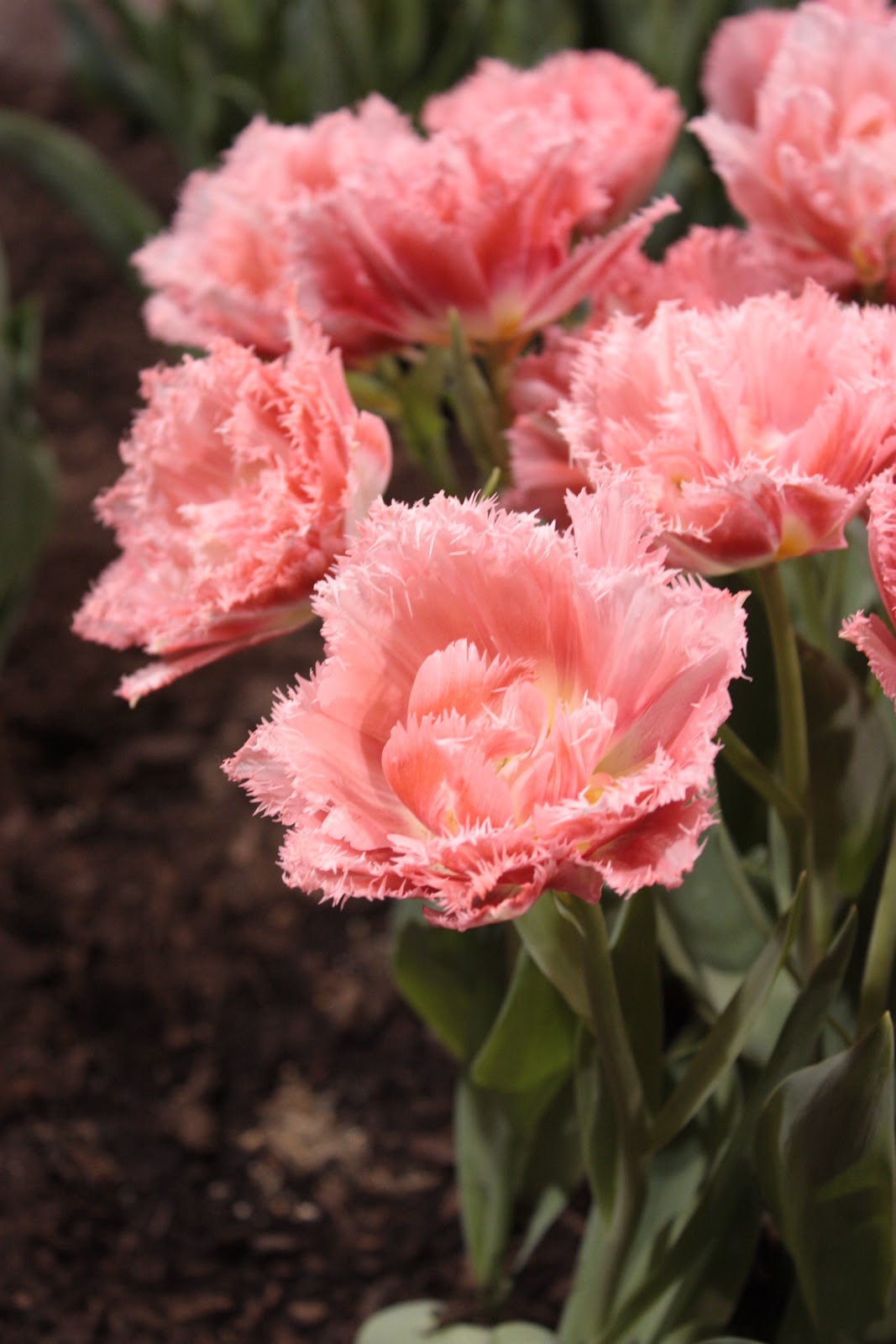
A fringed tulip

A double tulip

Mango tulips


Tulips and hyacinths, a very fragrant combination


There are also many great tablescapes.....


Plus there are two very special gardens -- one built to resemble the "Let's Move" kitchen garden outside the White House....


And another honoring the long-running NBC daytime drama, "The Days of Our Lives." It includes original props from the show plus the wedding gowns from four of the show's weddings.


One of the most breathtaking features is right at the entrance, a giant agapanthus sculpture by Britain's Jenny Pickford, a blacksmith and glassblower.


Back by a giant green wall, the 14' tall sculpture of forged steel and glass towers over visitors. It is 11 feet wide and weighs 1,100 pounds.


Show hours are from 10 a.m. to 8 p.m. Monday through Saturday, and from 10 a.m. to 6 p.m. Sunday. Admission prices vary from $15 to $19 for adults, depending on whether tickets are bought online or at the box office and whether they are for a weekday or weekend. Children ages 4 to 12 are $5 apiece.
 
By Karen Geisler

Thursday, February 23, 2012

Spring Flower Shows

Symptoms: Patient's heart rate elevated while reading plant catalogs. Body temperature rises when passing daffodils in grocery store. Husband reports frequently seeing patient in garden looking under dead leaves for signs of emerging plants. Possible mania suspected.

Diagnosis: Spring fever

Rx: A visit to the Lincoln Park or Garfield Park conservatories in Chicago to see historic azaleas and other plants in bloom. May substitute generic. Repeat as necessary.

Azaleas spring show Lincoln Park Conservatory
The Lincoln Park Conservatory
Yes, Chicago's winter has been among the mildest seen in the past 125 years. Only a few hyacinths have tentatively poked their heads out of the ground in my garden so far. And the buds on my witchhazel are just starting to swell. Somehow, none of this seems to help. I'm as anxious as ever for spring to begin.

I need green and I need it now. So it's time to make a trek to Chicago's conservatories.

The Lincoln Park Conservatory, located on Chicago's north side near Lake Michigan, has its annual spring show until Mother's Day. The Garfield Park Conservatory, on Chicago's west side, has a smaller-than-usual spring display for a few more weeks as it is still recovering from last summer's hailstorm. The blooms in its Horticulture Hall are still a delight.

Azaleas spring show Garfield Park conservatory
The Garfield Park Conservatory
Visitors also can enjoy a little bit of horticultural history at both locations. Many of the azaleas now blooming are directly descended from two varieties displayed at the 1893 Columbian Exposition in Chicago.

Actually, the term "azalea" is a bit of a misnomer. The evergreen shrubs technically are rhododendrons -- R. concinnum and R. scabrum 'Phoeniceum.'   Both hail from the Far East and were relatively new "discoveries" at the time of the Columbian Exposition. They probably were displayed in the fair's Horticulture Building as neither is hardy in Chicago.

These aren't the original plants, of course, even though azaleas and rhododendrons are long-lived. They are cuttings that have been taken from the originals. Many have been grown as small trees in pots that can be moved around for various displays.

Azaleas Garfield Park Conservatory
At the Garfield Park Conservatory
Both varieties have lavender/purple/violet blooms. So the Chicago Park District has added more modern varieties of rhododendrons and azaleas that bloom in complementary colors. The Lincoln Park Conservatory also has mixed in camellias, muscari, tulips, cyclamen and other foliage plants.

The effect is, well, like a spring tonic. Even though a major snow storm is threatening to hit the Chicago area later today, just looking at these pictures has me dreaming of the day I can get out in the garden again. As the prescription says, I'll just have to repeat as necessary.

By Karen Geisler


Historic azaleas at Garfield Park Conservatory
Rhododendron concinnum


Rhododendron near fountain Garfield Park Conservatory
Rhododendron scabrum 'Phoeniceum' at the Garfield Park Conservatory
flanks a fountain from Chicago's sister city of Casablanca, Morocco

 
Related Posts Plugin for WordPress, Blogger...

Share: