Monday, January 28, 2013

The Garfield Park Conservatory

Entrance view Garfield Park Conservatory
View from the entrance of the Garfield Park Conservatory
 
Every winter, there comes a time when I need a major infusion of green. Call it "cabin fever," "garden withdrawal" or whatever you like. It's a need that can only be cured by a glass ceiling, high humidity and lots of tropical plants.
 
I had a particularly bad case this past weekend, prompting a visit to the Garfield Park Conservatory in Chicago.
 
This complex, built 105 years ago, is truly a treasure. How can you not like a place that includes Spider Bouquet (Clerodendrum quadriloculore), Never-Never Plant (Ctenanthe lubbersiana), Yesterday, Today and Tomorrow (Brunfelsia australis), Song of India (Dracaena reflexa variegata) and Trailing Watermelon Begonia (Pellionia repens)?
 

Palm Room at Garfield Park Conservatory
The Palm Room at the Garfield Park Conservatory

The Palm Room, which greets visitors off the main entrance, is impressive to say the least. In addition to the various palms, there are several orchids currently in bloom including potted Cymbidiums, Nun's Hood orchid (Phaius tankevilliae) and ground orchids (Spathoglottis plicata cultivar).
 
Hood orchid at Garfield Park Conservatory
Nun's Hood orchid
 
The conservatory's famed Fern Room also is open again after being devastated by a hail storm on June 30, 2011. Some parts haven't been replanted yet and won't be until the damage is permanently repaired this coming summer. It still is a tranquil retreat.
 
Waterfall, Fern Room, Garfield Park Conservatory
One of two waterfalls in the Fern Room
Pond, Fern Room, Garfield Park Conservatory
The central pond in the Fern Room
Fishtail ferns in the Garfield Park Conservatory
Fishtail ferns on the mossy rocks of the Fern Room
View of Fern Room at Garfield Park Conservatory
Another view of the Fern Room
There's a lot more to see, but I ran out of time. I'm sure I'll be back before spring finally comes to the Chicago area. While amaryllis, paperwhites and various plant and seed catalogs help, they only work for so long.
 
Where do you go when you need a green "fix" this time of year?
 
By Karen Geisler
 
 
White Bird of Paradise, Palm Room, Garfield Park Conservatory
White Bird of Paradise in the Palm Room


Palmetto palm, Garfield Park Conservatory
Palmetto Palm

Jungle Flame flower Garfield Park Conservatory
Jungle Flame
Mexican Horncone, Garfield Park Conservatory
Mexican Horncone
Ground orchid, Garfield Park Conservatory
Ground orchid


Crocodile fern, Garfield Park Conservatory
Crocodile fern
Spider Bouquet at Garfield Park Conservatory
Spider Bouquet

Sunday, January 20, 2013

Everblues

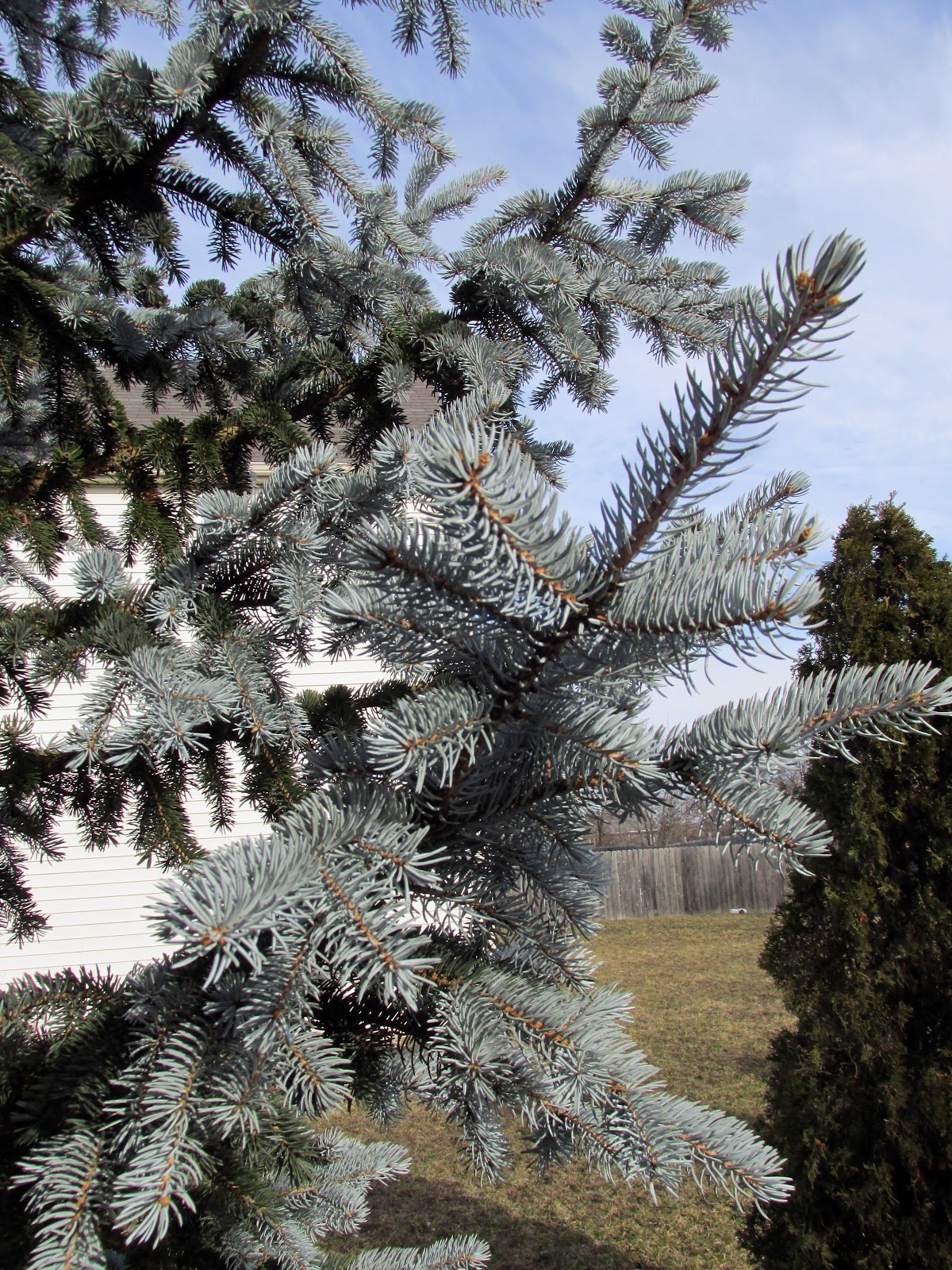
Hoopsi blue spruce
Hoopsi Colorado blue spruce
Living in the Chicago area, I've always appreciated the blues -- especially those in my garden during the winter.

I have nine evergreens with blue or green and blue needles that provide much needed color this time of year. For most of the growing season, these conifers retreat into the background, providing texture and a nice backdrop for the perennials and shrubs. In the winter, though, they take center stage.

It wasn’t always this way. Evergreens and I started out like Elizabeth Bennet and Mr. Darcy in Jane Austen’s Pride and Prejudice. I thoroughly disliked the scrubby junipers in the foundation planting at my first house as well as a taller, sharp-needled juniper near the front door that seemed to attack every visitor. They were quickly removed. I vowed never to plant an evergreen.

Living through a few snowy Minnesota winters with next-to-no color in my back yard softened my position. I planted an arborvitae to screen my wood pile.

Then I moved to the Chicago area where I eventually worked part-time at a nursery specializing in dwarf conifers. It was an eye-opening experience, to say the least. I never realized that evergreens came in so many sizes, shapes and colors besides green. Many are slow-growers or very narrow, perfect for typical urban lots.
 
Blue quickly became my favorite because it complements the purple, blue and pink flowers I tend to plant. Call me old fashioned, but don’t call me late for dinner.

Here are my "everblues."


Dwarf globe Colorado blue spruce


1.)    Dwarf Colorado Blue Spruce. (Picea pungens glauca globosa) A globe that anchors the main bed in my front yard. A slow grower, it will eventually be about 3-5' tall and wide. A nice complement to blue oat grass (Helictotrichon sempervirens). 
 

Hoopsi blue spruce


2.)    Hoopsi Blue Spruce (Picea pungens ‘Hoopsii’).  Tall, thin and true blue. A slow grower, it will eventually reach 20-30' tall, and just 5' wide. It was the first evergreen I planted after moving to my current home and the tallest one.


Blue Star juniper

3.)    Blue Star juniper (Juniperus squamata ‘Blue Star’). A small ground hugger, only 2-3' tall and 3-4' wide at maturity. The needles take on a bronze tone during the winter.


Vanderwolf's Pyramid limber pine with needle closeup
 
4.)    Vanderwolf’s Pyramid Limber Pine (Pinus flexilis ‘Vanderwolf’s Pyramid’). These branches with their blue and green needles are verrrry flexible, a plus if you have small children running around in your back yard. Open habit. Another slow grower, its eventual height is estimated at 20-25' tall and 10-15' wide.
 
Blue Shag white pine

5.)    Blue Shag white pine (Pinus strobus ‘Blue Shag’). This round ball with blue and green needles is a slow grower but could eventually become 5' by 5'. Located near my front door, it blends particularly well with perennials.

Candicans white fir
 

6.)  Candicans white fir (Abies concolor 'Candicans'). Wonderfully thick blue gray needles. Will gets to be 30' tall and 10' wide. Has purple pine cones. My neighbor actually asked me if the pine cones were real!

The following are harder to find, but be sure to pick them up if you spot them.
 
Blue Serbian spruce

7.)    Blue Serbian Spruce (Picea omorika ‘Glauca’). I love the swooping nature of the branches and the blue color makes it even more special. Eventually will reach 50-60' high and 20-25' wide.

Yukon Blue white sruce
 

8.)    Yukon Blue white spruce (Picea glauca ‘Yukon Blue’). This evergreen has short needles that are almost a “smoky’ blue and cute, tiny pine cones. It supposedly will eventually reach 12' tall and 5' wide. Another slow grower, it isn't in danger of reaching that anytime soon.

 
Blue Tear Drop black spuce

9.)    Blue Tear Drop Black Spruce (Picea mariana ‘Blue Tear Drop’). Its foliage is an unusual shade of blue grey and its branches are slightly droopy. Will only get to about 3-4' in 10 years.

Of course, I do have an extensive wish list. It includes a Dream Joy juniper (Juniperus squamata ‘Dream Joy’) which has blue needles and yellow tips. Ah, conifer lust!!

I am watching my evergreens particularly close this year because of the ongoing severe drought in my area. They generally don’t show the signs of stress until the fall when they have their annual needle drop. Evergreens also can dry out quickly in the winter because the frozen soil doesn’t allow the roots to replace the moisture lost through evaporation.

I kept watering them well into November (and have the water bill to prove it). Our precipitation is still about 10” below normal and -- with little snow cover -- it looks like that won’t be changing anytime soon.

Still, I’m willing to keep it up and provide some TLC next spring. Without my blue evergreens, I’d definitely have a bad case of the winter blues.

By Karen Geisler


Dwarf globe and Hoopsi blue spruces
Globe Colorado blue spruce with Hoopsi blue spruce in the background

Sunday, January 13, 2013

Going with the Grain


Tree ring print by Bryan Nash Gill
From Woodcut by Bryan Nash Gill
Published 2012 by Princeton Architectural Press
 
Everywhere you look, people are going with the grain -- wood grain, that is.

You'll find such patterns everywhere -- on fabrics, wall coverings, wedding and baby shower invitations, iPhone covers, lamp shades and even stitched onto pillows and leather wallets. The list is endless.

It's all part of a movement known as eco-chic -- bringing the outdoors in, whether it's in a rustic, retro or modern sophisticated way. BrandWave, which forecasts global design and branding trends, issued an alert on wood grain in November. And even Michael's, the arts and craft store, mentioned wood grain in its recent press release about 2013 trends.

I've always been a bit cynical about trends -- here today, gone tomorrow -- but I have to admit I have long been fascinated with wood grain. If every picture tells a story, then every piece of wood tells the history of the tree from which it came. Each image is as unique as a fingerprint.

Tree rings, for example, can indicate the amount of rain, the temperature, soil pH, nutrition and carbon dioxide concentration, to name only a few factors. There’s even a name for the study of tree-ring dating – dendrochronology – and a laboratory of tree-ring research at the University of Arizona. But that's the gardener in me talking.

Scientists, of course, aren’t the only ones concerned with wood grain. Artists and craftsmen have long used it in their work. My late father turned wood in his workshop on nights and weekends when I was growing up, making gavels, bowls and vases. Each was a delight to behold.

Perhaps the best (and strangest) merger of art and science came in 2011 when Bartholomaus Traubeck of Germany figured out a way to "play" wood cross sections on a record player. Check it out here. Sounds a bit chaotic, not unlike Nature itself. 

Me, I’ll stick with something a bit more traditional -- prints taken from tree cross sections.  An exhibit of 31 original prints by artist Bryan Nash Gill will open Saturday, Jan. 19 at the Chicago Botanic Garden and run through April 14.

Gill published a book of his prints, Woodcut, in April last year to a very favorable review in the New York Times. His work has been displayed worldwide, although this will be his first Midwest show.

Most of his prints are made using cross-sections of wood salvaged near his home in New Hartford, Connecticut. This exhibit, though, will include the print English Oak made from a tree at the Chicago Botanic Garden. The tree was one of a pair along a back road near the Dixon Prairie. It had to be removed when the two trees started to grow into each other, diminishing the health of both. (The remaining tree has since returned to full health.)

The exhibit will include three custom benches made from an ash tree at the Chicago Botanic Garden that was removed after being infected with Emerald Ash Borer. There also will be a video of Gill at work. He sands and burns the wood, then makes the print by carefully pressing paper down on the individual ridges. Each print is made by hand, so each is slightly different.
 
BCBG MaxAzria wood print dress
Of course, there's always the question of what to wear to such an event. I thought about wearing this. Or maybe a dress (left) worn by reality star Toya Wright at a birthday party last fall.

On second thought, maybe I'll just stick to  jeans and a plain sweater.

As someone who has added 12 trees over the past five years, I hope all this hoopla about wood grain will have a positive effect. May it inspire people to go out and plant a tree. Or at least go out and hug one.

By Karen Geisler
Related Posts Plugin for WordPress, Blogger...

Share: