Thursday, September 1, 2011

Metallic Blue Lady


Metallic Blue Lady Lenten rose
Hellebore orientalis 'Metallic Blue Lady'

The foliage of 'Metallic Blue Lady'

 I'm not easily impressed by a perennial, but I recently saw one that knocked my socks off -- a hellebore or Lenten rose called 'Metallic Blue Lady.'  The leaves this time of year have a wonderful silvery sheen. In spring, it has a dark, dark purple flower.

It reminded me that fall is a good time to plant, especially when it comes to spring-blooming perennials like hellebores. Planting now allows them to develop a strong root system. The soil is warmer now than in spring, making it easier for them to get established. And cooler air temperatures (believe me, they are coming) will further encourage root development instead of growth above ground.

The same thing applies to a lot of other plants as well. Peonies, for example, are best moved in the fall. Also, if you plant mums early enough, they have a better chance of coming back on their own next year. So if you want to brighten up your garden next spring, doing a bit of planting this fall can put you ahead of the game.

Monday, August 29, 2011

Hibiscus


Flowers of Cranberry Crush hibiscus
'Cranberry Crush'
Say the word "hibiscus," and most people think of the colorful tropical plant that's parked on countless patios every summer.

What many don't realize, though, is that there's a hardy perennial version that blooms from this time of year until frost. Its large flowers are a welcome addition to the garden at a time when few other plants are still providing color.

That is especially true this year when our extensive stretch of 100-degree weather prompted many long-blooming plants to stop earlier than usual. Heat exhaustion, I guess.

Hardy hibiscus flowers can be very large, 8 to 12 inches across, and the plants need to be staked as a result. Some people unfortunately avoid them as a result and that's a shame. The plant has come a long way in recent years and are worthy of a second look.

Initially, hibiscus moscheutos only came in red, pink or white and had rounded leaves like hollyhocks, another member of the mallow family. The latest hybrids come in a broader array of colors and have much more intersting leaves that provide year-round interest.


Leaves of Cranberry Crush hibiscus
The leaves of 'Cranberry Crush'
Cranberry Crush, for example, has reddish-green lobed leaves and almost black buds that open to a scarlet red flower. Copper King has leaves that turn a copper color in the fall.

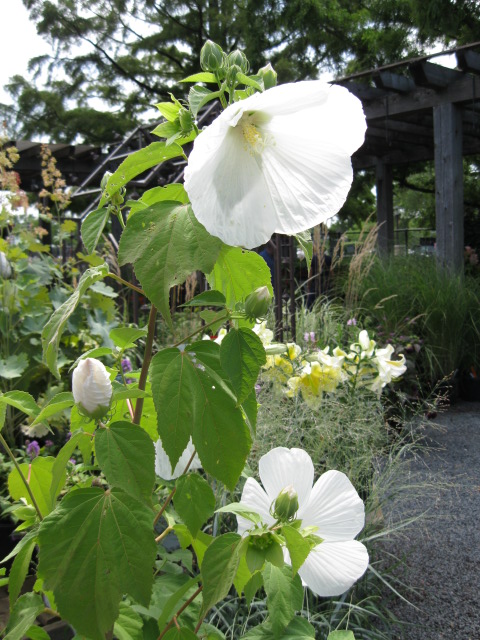
And then there's Blue River II, which despite its name, has the purest white flowers you've ever seen. It would be fantastic in a moon garden.


Blue River II hibiscus
'Blue River II'
Because these beauties are late to bloom, they also are late to wake up in the spring -- as late as early June, depending on the weather. One of my former neighbors who had these in her yard was constantly fighting the urge to dig these up every spring because she feared they had died.

Hardy hibiscus are hybrids of native wildflowers, though, and they returned reliably, year after year, even with the cold Minnesota winters. They especially work well with spring bulbs as the bulbs are finished blooming by the time the hibiscus starts growing.

These plants started out in swamps so they like consistent moisture for the first year. But once established, they can withstand drought. They need at least six hours of sun and keep blooming despite sweltering temperatures.

Hardy hibiscus don't have the same insect problems that tropical hibiscus can, although be on the lookout for Japanese beetles. Hibiscus should be cut back after a hard frost to about 12 inches and mulched.


Peppermint Schnapps hibiscus
'Peppermint Schnapps'

So if you want some color in your garden when all the kids (or grandkids) are back in school and the temperatures outside are a bit more comfortable for lounging, take a look at hibiscus. You don't need to move to a tropical isle to enjoy them.

Sunday, July 24, 2011

Daylilies

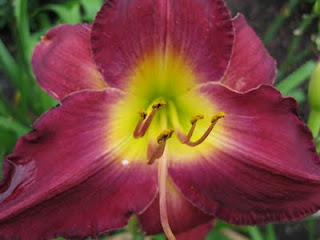
Bela Lugosi daylily
'Bela Lugosi' daylily

Nothing says summer more than daylilies.


Coneflowers may come close, but I’m always thrilled when the first daylily breaks into bloom. That’s when I know summer is in full swing. Time to break out the lemonade and barbeque sauce.

The botanic name of daylilies, hemerocallis, comes from the Greek words for day (hemera) and beautiful (kalos) as each flower lasts only one day. They generally bloom from sunrise to sunset, which makes their beauty even more precious.


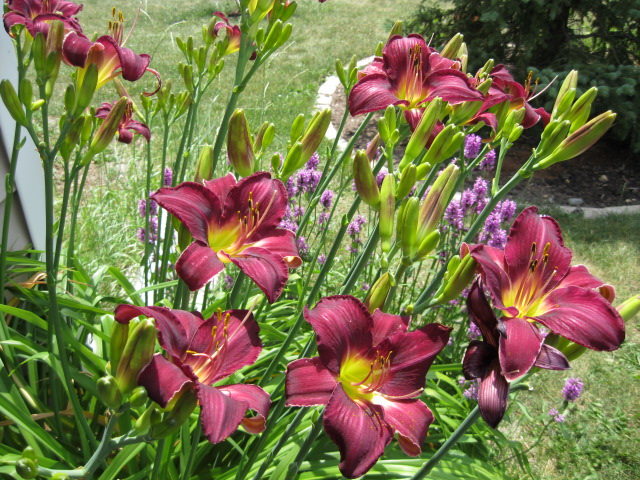
Lavender Deal daylily
'Lavender Deal' daylily

There are literally thousands of colors and shapes to choose from: the traditional or diploid ones, tetraploids with thicker petals and larger blooms, doubles, triples, spiders, those with ruffled edges or “diamond dust,” even some with fragrance.

That’s a far cry from the orange daylilies (hemerocallis fulva) that grew in my backyard when I was a kid. My father mowed over them not once but twice, claiming they were a "weed.” Of course, they bounced back better than ever.

Ironically, many states now agree with my dad’s assessment. These lilies -- also called tiger lilies, ditch lilies, roadside lilies and even outhouse lilies -- are considered an invasive weed in several states including Wisconsin. They spread by rhizomes, or underground roots, and are almost impossible to get rid of once they’re planted. While that’s good if you have a problem spot in your yard, it can be a problem if you ever change your mind. You need to remove every little bit of root, and I mean EVERY bit.


Spiritual Corridor daylily
'Spiritual Corridor' daylily

The newer varieties, for better or for worse, aren’t quite so vigorous. They need the same care as any new perennial, at least for the first year. You can’t just plant and forget about them like the fulva daylilies. One of my husband’s college friends unfortunately learned that in a big way one year when all of his new daylilies died.

And modern daylilies aren’t exactly low maintenance. They eventually will shade out most weeds that try to grow underneath them, but you need to break off the spent blooms, or deadhead, for them to look their best. That’s especially true with the larger, darker blossoms. The old blooms will eventually fall off, but they make the plant look messy until then.


Wayside King Royale daylillies
'Wayside King Royale' daylilies
Many people think daylilies are native, but they’re not. They started out in Asia and came to the U.S. via Europe. Early settlers bought two types of daylilies with them -- orange (fulva) and yellow (flava). The latter, also known as the lemon lily, is much more well-behaved than its counterpart. It doesn’t bloom as much as the yellow Happy Returns daylily you find everywhere nowadays, but it blooms early and has a great lemony fragrance that I love.

Daylilies started getting fancier in the 1920’s and 1930’s and have been going strong ever since. I currently have mostly purple daylilies in my garden. There’s Lavender Deal, Wayside King Royale, Bela Lugosi, Fuschia Dream, Chicago Arnie’s Choice, Prairie Blue Eyes, Swirling Waters and Little Grapette.

Other daylilies that I’ve grown include Catherine Woodbury, Lilting Lavender, Cherry Cheeks and Joan Senior.
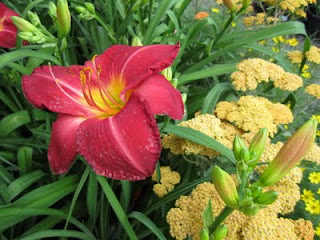

Charles Johnston daylily
'Charles Johnston' daylily

My wish list includes Charles Johnston, a great-looking red flower, and one of the late-blooming varieties such as Autumn Minaret. I saw the latter planted in some containers in Minneapolis one fall and it was spectacular at more than 5-foot tall.

What are some of your favorites?

By Karen Geisler
Related Posts Plugin for WordPress, Blogger...

Share: