Tuesday, November 5, 2013

Tulips and Cows (Tulpen en Koeien)

Did you know that it is standard practice in Holland to remove tulip flowers as soon as the growers see the color is true? Once the buds have opened the bulb growers bring in the kopmachine to behead the tulips. The beautiful flowers are often fed to cows, who I've read allegedly eat the red ones first. Really?


One way to protect your tulips from the neighbors' cows is to grow them in your window over the winter. Splashy Amaryllis and fragrant paperwhites need no prechilling to bloom in your home. Plant them at room temperature and they're quick to sport their fancy flower finery for you. The other spring bulbs (daffodils, tulips, hyacinths, crocus, etc.), however, must be prechilled to flower successfully indoors.


The bulbs just need to be hoodwinked into thinking they've already been exposed to 10-12 weeks of 35-40 degrees F., just as if they were in your garden all winter. There are different ways to accomplish the same gorgeous result.

The most commonly accepted way of forcing the "major" bulbs is to pot in a good quality potting soil. Don't fuss over whether to use clay or plastic pots. Just make sure there are drainage holes. The spring flowering bulbs can't stand heavy, wet soils. Select a pot that will hold at least: 5 daffs, 5-7 tulips, 3 or more hyacinths, 5 or more crocus. For forcing, remember you want maximum effect, so the bulbs can be almost touching. The necks of the bulbs should be slightly above the soil surface. Be sure and leave a water space between the soil surface and the rim of the pot. When those little roots start growing they will push the bulb up a bit in the pot!

One trick is to put the flat side (yes, there is one) of each tulip bulb against the outside of the pot. The first leaf will roll out over the side of the pot and frame the flowers perfectly all the way 'round the container. While we're talking tulips, consider using single early, double early, double late or Triumph "classes" as the best for indoor forcing. Once the bulbs are planted, water thoroughly.


Then you have choices to make. You can achieve the required chilling by placing the potted bulbs in the refrigerator bins for the aforementioned 10-12 weeks. Make sure there are no ethylene gas producers in the same bins as the bulbs. Edibles like apples, apricots, avocados, bananas, cantaloupes, honeydews, kiwis, peaches and tomatoes all produce varying amounts of ethylene which can deform the flowers.
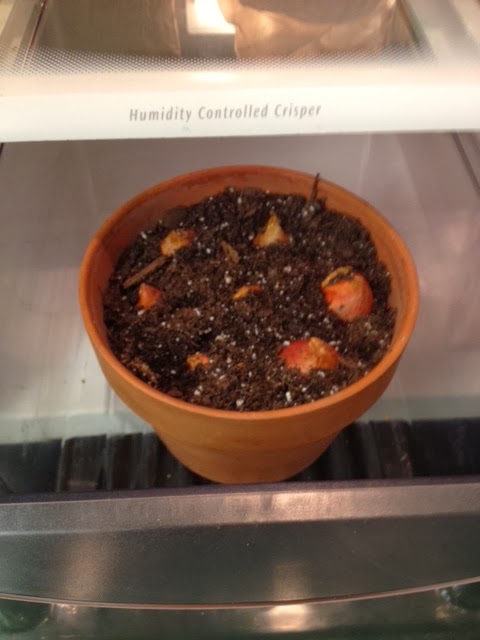

If you'd rather not have your Sub-Zero used as a "bulbarium", you can place the bulb pots down in your window wells, an often overlooked horticultural storage unit. This will put the bulbs below the frost line and keep the soil from freezing. Cover with a light layer of straw for insulation. Like the refrigerator, the bulbs will start forming roots and be ready to retrieve and bring to the light-of-day after the chilling time is met.

If the family isn't keen on a refrigerator full of potted bulbs and you don't have window wells, there's a last option that has been EASY and successful for me. I simply put the bags of bulbs (which need to have openings or air holes so there's no condensation on the inside) in the refrigerator bins. When the chilling is complete, pull 'em out and pot 'em. The bulbs don't care whether they were potted or not while they're chilling.


Once chilled and potted, you'll place the pots in a bright window in a cool room, 65 degrees or less, while roots are forming. Water thoroughly so the water goes through the pot, then drain. In particular, it's great if you can keep them cool from rooting to flowering. As long as they're getting enough light the cool temperatures will keep them short and stocky, and the flowers will last longer than in a warm room. If they must move to a warm room try to keep them as cool as possible for the first couple of weeks. Roots have usually started once you see the green stems growing out of the neck of the bulb. Then you can move them to the place where you want to enjoy them.

Once they've finished blooming don't waste your time trying to save and reflower them. Forcing exhausts their food reserves. Like a cut flower bouquet, when it's over, it's over.   
   

Friday, October 25, 2013

To Be OCD or Not to Be in the Perennial Garden...

That is the question: Whether 'tis nobler in the garden to suffer the slings and arrows of a million outrageous Echinacea seedlings next spring, or to wield pruners in the autumn against a sea of slug-infested Hosta foliage and by cutting, end their miserable looks for the year.*

I'm not embarrasssed to say that I'm an obesessive-compulsive gardener. Some people proclaim fall their favorite season. Not me, thanks. Bushels of leaves that drop the minute you finish mowing the lawn, peonies that have succumbed to measles and powdery mildew, daylilies that continue to produce brown leaves as soon as you groom them. Wow- what's not to love about the fall garden?


There's something soothing about the aesthetics of a clean fall garden. It's a little like getting the kids tucked in and asleep before Santa arrives. Smug satisfaction, for sure. How nice not to have Calamagrostis refuse rolling like so much tumbleweed over the winter lawn. We don't want our Arborvitae splayed open. Why should ornamental grasses be different? Certainly if you desire "tidy" and cut your perennials back in the fall try to wait as long as you can. If the plants are in full color they're only getting stronger with each additional day they make and store food. In a perfect world, we'd wait for at least one hard freeze before reaching for the pruners and machete.

Consider your schedule. Isn't fall really a slower gardening time for you than spring? What happens when snow sticks around and soil stays frozen? Or, it rains and/or gets warm early and new growth starts emerging through last year's detritus. It's hard to name another gardening chore that's as tedious as pruning dead litter without damaging fresh new growth in the spring. Just my perspective.

Aphids, slugs, leaf spots, blights, pestilence in general, linger around those plants sticking out of yonder snow bank. Removing the debris in the fall, leaving stems 1-2" tall, theoretically reduces the overwintering populations of livestock and disease. Good fall garden hygiene should translate into fewer "pest" issues next year.

In the interest of balance and full disclosure, certainly there are things I leave standing. Of course, evergreen perennials (Iberis, Hellebores, many ferns, some true Geraniums and Bergenia, to name a few) must stay. Why not compromise? If you like the looks of a plant over the winter leave it. Weigh whether its winter long beauty is worth  having to cut back in the cold, driving rains of March.


While I'll admit the sight of rabbits and deer (in my garden) raises my testosterone and blood pressure, there is something to be said for the cover and potential fodder that perennials afford wildlife.  I do believe in doing whatever I can to create a healthy diet for our feathered friends- rabbits and deer, not so much. Admittedly, many perennials provide delicious life-sustaining seeds. That's a huge reason not to deadhead or cut back certain plants (Echinacea, Heliopsis, Rudbeckia, for starters).

Mother Nature always does things for a reason. Leaf and stem debris surely provide necessary insulation, probably increasing winter hardiness. Come to think of it, isn't that why we mulch? Still, if you're obsessive, maybe the compromise is not cutting back marginally hardy perennials in the fall. Leaving the foliage to keep the ground frozen may lessen the effects of the vicious freeze/thaw cycles that can wreck havoc on Midwest perennial gardens.

Another advantage in leaving perennials standing through winter is to mark the specific location of late-emerging species (Hibiscus is a perfect example, often not emerging from hibernation until June). That may prevent you from slicing through the crown with a well-intended, but misplaced, spade.

As I reread this it comes down to the old maxim, "Beauty is in the eye of the beholder." Your call.

*My apologies to William Shakespeare and my 9th grade Humanities teacher, Mrs. Ogden.

Saturday, October 5, 2013

A Pumpkin Primer

Knucklehead, Orange Warty Thing, Wolf

This is not a joke or a riddle, honestly. Do you know how beets and turnips relate to our present day pumpkin carving tradition? I sure didn't. It seems the Irish used them during the festival of Samhain, meaning summer's end (October 31-November 1). Beets and turnips were the commodity vegetables of the day. They were hollowed out and then (usually) a diabolical face was carved on the front to emit light. Initially, burning lumps of coal were placed inside to create light. Later candles were substituted.

Green Warty Thing

There are a wide range of other-worldly theories on why the need existed in the first place. October 31st was believed to be very magical. The atmosphere was at its "weakest" point of the year on that night. So, the barrier between the living and dead was more easily breached, allowing people to honor the departed. Many felt this light would protect them as they walked about outside that night. Or, one's home might be protected from the spirits by setting the turnip or beet in a window by the door. See a tradition starting here?
  
Wolf

Then there are the conflicting stories of "Stingy Jack" tricking the devil on different occasions with the same end result. As a punishment for his devious ways the devil gave Jack a burning ember to go forth into the night. It is said that Jack carved out a turnip, put the devil's coal in it and wandered the earth ever since. Jack-of-the-lantern became  "jack o'lantern".

One Too Many

When the Irish began immigrating to America they discovered pumpkins. I say "discovered" as pumpkins are natives to our side of the world. As you might well imagine, it must be a lot easier to carve a pumpkin than a turnip or beet. I didn't try it, but I'm pretty sure that must be the case.
 
Cinderella

Today's beautiful orange pumpkins are fruit, not vegetables. They are closely related to squash, cucumbers and melons. If you're tempted to grow them next year find a site with lots of sun, well-drained soil and be prepared to give the vine lots of elbow room. I mean that literally or they will clamber over their garden neighbors. If you're serious about larger pumpkins, select seed varieties that have been bred for that characteristic. Still, be prepared to fertilize and water regularly. Producing big pumpkins requires both the right genetics and continuous care.
 
Pie Pumpkins


Pumpkins are harvested when they have full color. Jack o'lantern-sized pumpkins (5-10 lbs. or larger) can be used for carving or baking. Hybridizers have done amazing things through selection and breeding to give us today's beautiful "gourds" with colors we never saw as kids.

Happy Samhain to all!

Related Posts Plugin for WordPress, Blogger...

Share: